

The 1st day of the workshop started after a get-acquainted welcome reception at Katrina Christiansen restaurant. The following morning Høgni Hoydal, the Faroese Fisheries Minister, opened the workshop with a welcome address highlighting the importance of fisheries for the Faroese economy. He included discussion of the observed changes across time with the implementation of UNCLOS in the late seventies, when the EEZs were established, which both limited the Faroese fisheries around the world but also have given the Faroese ‘a sea of their own’. The minister also welcomed the anticipated changes under the new Faroese fisheries reform – the Act on the Management of Marine Resources.

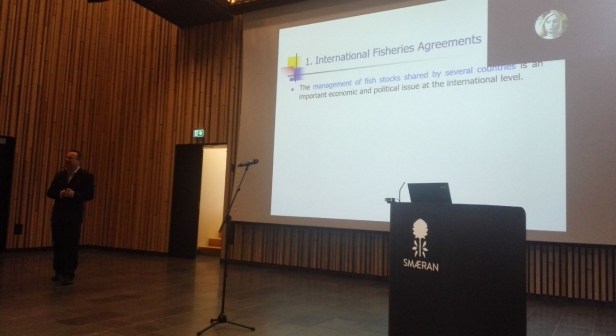
Pedro Pintassilgo (University of Algarve) gave the workshop’s keynote lecture on ‘‘International Fisheries Agreements: A Game Theoretical Approach’’. He described the main difficulties in cooperative management of international shared fish stocks. It is well established in the fisheries literature that more need for cooperation leads to lower chances for successful agreements (paradox of the global commons). In addition to that, the higher the number of players the higher are the gains from cooperation but the lower is the success of coalition formation. New entrants, joining the RFMO (or not), increase the incentive of members to leave, and decrease the incentive of nonmembers to join. Last, the prospects of stable cooperative agreements increase with players’ cost asymmetry and decrease with the overall efficiency level. Pedro also described the most recent advances in the literature and gave an overview of game theoretic tools used for studying strategic interactions between decision makers, putting an emphasis on partition function games and non-cooperative games of coalition formation.
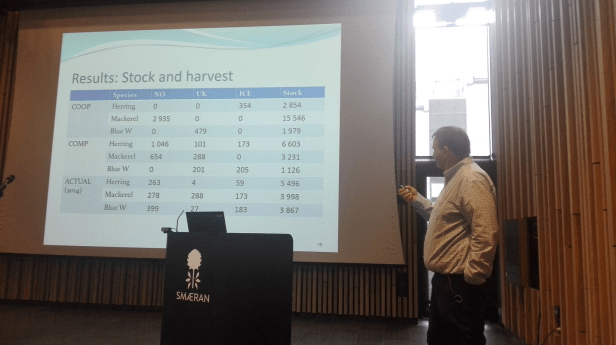
After Pintassilgo’s keynote lecture, Nils-Arne Ekerhovd (SNF Centre for applied research at Norwegian School of Economics) presented a dynamic model with three interacting species (herring, mackerel, blue whiting) and three agents on a common fishing ground (Norway, UK and Iceland). The model takes into account biological interaction between the species and strategic interaction between the agents simultaneously. He explained the internal and external stability conditions, for all possible coalition structures in steady state in order to establish how coalition structures are most likely to occur, with and without side-payments. He concluded by comparing the model’s findings with real-world observations where we see that full competition where all players behave myopically is the most likely outcome.
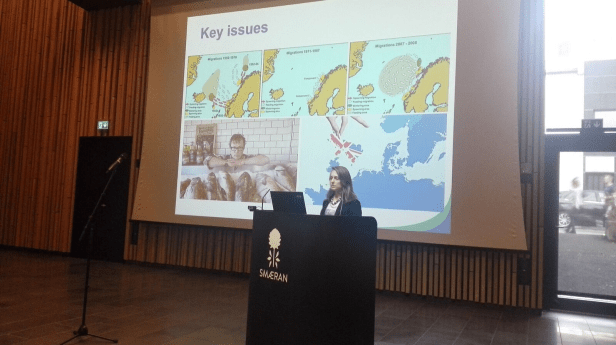
In the presentation that followed, Sandra Rybicki (Thünen Institute of Sea Fisheries) addressed the question of how ocean-warming driven distribution changes of highly migratory species such as the Northeast Atlantic mackerel and herring, are expected to affect key fishing opportunities. In doing that, she explained how she and her team of co-authors have been using FishRent, an integrative optimization and simulation bio-economic model. Her main modelling approach focuses on two climate scenarios, the “World Market” scenario and the “Global Sustainability” scenario. Those scenarios allowed her to explore respectively a case of unsustainable exploitation with significantly increasing CO2-emissions and a case of sustainable fisheries by examining the effects of measures such as Marine Protected Areas.
Staffan Waldo (Swedish University of Agricultural Sciences) presented next on international collaboration for the simultaneous management of fisheries and eutrophication in the Baltic Sea. A particularly relevant nuance that has not been considered in policy making is that fisheries management plays an important role in regulating nutrient dynamics in the sea. He analysed the value of nutrient removals under the use of three different fisheries management instruments in the Danish, Finnish and Swedish pelagic fisheries; namely Individual Transferable Quotas (ITQs), subsidies for nutrient removals, and a requirement to land fish above the Maximum Economic Yield (MEY) level. For the purposes of his analysis he used the FishRent model and examined the effect of 3 policy scenarios. His results showed that catches above the MEY, together with a joint ITQ system for all 3 nations, yielded the highest socioeconomic gain.
Suzannah Walmsley (ABPmer) and Erin Priddle (Environmental Defense Fund) then jointly presented their work on resilience of fisheries governance in the North East Atlantic. They started off by identifying the institutional and governance-related challenges that climate change brings for fisheries management. They pointed at political pressures such as Brexit and further elaborated on opportunities and risks for fisheries governance. They examined closely the potential break-down of agreements among coastal states and unilateral quota setting in the light of shifting distributions of fish stocks due to climate change. Using case studies from the North East Atlantic and the rest of the world (e.g. Norwegian spring-spawning herring, blue whiting, mackerel) they highlighted the key features needed for an adaptive, flexible fisheries governance framework that can adequately respond to climate change-related challenges.
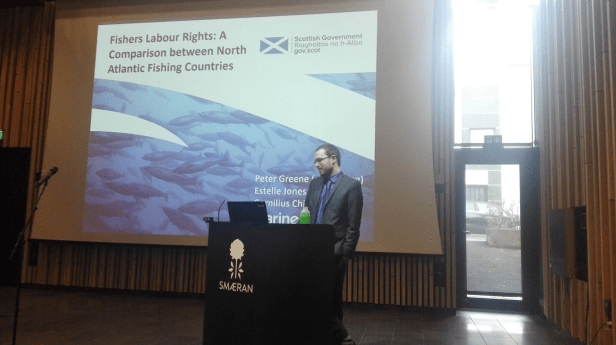
Following the lunch break, Peter Greene (Marine Analytical Unit, Marine Scotland) brought up the critical issues due to the absence of policies and laws that can ensure transparent, fair, and ethical employment practices on fishing vessels. He argued that despite the existence of various regulatory frameworks for marine governance, allegations of poor working conditions and payments are key sources of concern. Through an exploratory analysis of North Atlantic fishing countries’ domestic legislation, their treatment of fishers’ rights and their implementation of international conventions, he concluded on potential impacts on countries’ comparative advantage as a key element for future trade agreements and explained why multilateral action is of prime importance.
Hazel Curtis (Seafish) presented next on the importance of external labour force for UK catching and processing sectors. Specifically, she presented the results from a pilot survey on employment for the UK fishing fleet as well as the results of a survey on the nationality of workforce in UK seafood processing companies. Through an analysis of the results, she showed the discernible role that external labour force plays for UK fishing and processing industries while highlighting some sectoral differences within each of the industries. Foreign workers from other EU countries made up for the majority of people employed in the surveyed seafood processing sites; region and site size were found as the most influential factors for the nationality mix of the workforce. In the fishing sector the majority of workforce had UK citizenship; though in certain regions specific fleet segments (large vessels operating offshore) the importance of external labor force was found to be higher.

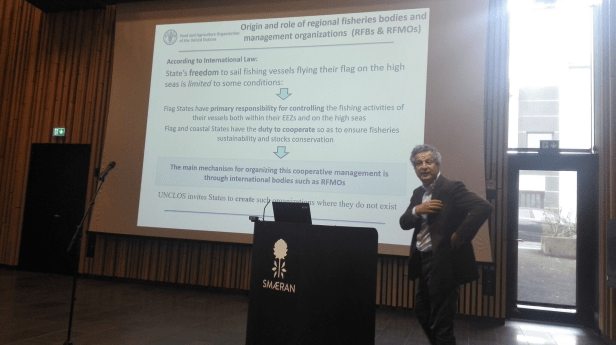
Piero Mannini (FAO, Fishery and Aquaculture Department) brought attention to the emerging role of RFMOs, which require States to establish regional organizations; States need to fulfil their duty to cooperate on the long-term conservation and sustainable management of their fish stocks. The poor condition of many shared fishery resources has brought to light the gaps in Regional Fishery Bodies (RFBs) and RFMOs and has made policy makers embark into a debate on how to reform and strengthen the international fisheries management regime. Pierro used a number of examples of RFBs and RFMOs at an international level, such as from the Eastern Central and Southeast Atlantic, and pointed at challenges, opportunities and emerging issues within the framework of regional and global fishery and aquaculture governance.
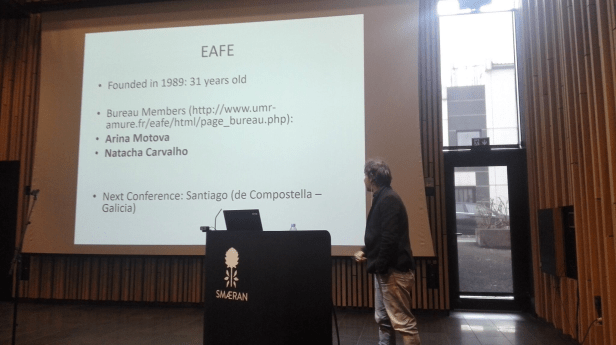
Following the afternoon coffee break, Arina Motova (Seafish) presented the work of Seafish on the utilization of the EU-Faroe bilateral agreement by the UK, the rest of the EU, and the Faroe Islands for 2014-2016. The agreement, which is annually negotiated, focuses on quota exchange and access entitlement; both allow one party’s vessels to fish in the other party’s waters. For 2016, EU vessels landed 24% of the permitted landings that could have been made from Faroese waters while Faroese vessels landed 84% of the permitted landings that could have been made from EU and Greenlandic waters. Regarding the fleet, Arina noted that the access agreement a) is of much greater value to the Faroe Islands, which is due to fish quality in EU waters (mackerel) and lower costs associated to fishing (blue whiting) and b) offers no benefit to the UK but is rather costly, for especially the Scottish Government, due to monitoring and compliance duties. Regarding the pelagic processing sector, she highlighted that the landings tax imposes a barrier to achieving benefit from the agreement while also that there is unfair competition in markets for mackerel and blue whiting from EU waters due to the fact that the quality is equal but the costs are lower for the Faroese product. The full report can be accessed here.

Hans Ellefsen (Faroe Islands Ministry of Fisheries) provided a thorough analysis of the newly implemented fisheries reform in the Faroe Islands. Based on the principle that all living marine resources are property of the Faroese people, the core idea of the reform is that fishing licenses shall never become private property by either law or practice. The licenses cannot be traded directly between private buyers and need to go instead through a public auction. The previous system of days-at-sea for longliners and trawlers targeting demersal fish will be replaced in 2019 by a quota system. Smaller scale coastal vessels, however, will continue with the annually allocated fishing-days system. Hans highlighted the novel element of the legislation, which is the open public quota auctions; those apply to 15-25% of overall quotas for major species. When quotas for those species exceed certain quota levels in the future, they will be auctioned off entirely. While all industry actors will have access to the remaining quota by paying a resource fee in accordance to their profits in previous years, licenses will only be granted to Faroese operators. Partaking in Faroese fisheries will require the company or the individual to be registered and to pay taxes in the Faroe Islands, and to pay the crew in accordance with Faroese labor market rules and agreements. Foreign ownership will be phased out within six years while special rules apply for Icelandic ownership with a seven-year plan.

In my presentation I addressed the challenges associated with management and ownership of increasingly northerly distributed species in the light of the global fish stock depletion, as well as risk and uncertainty over future fishery resources. I used the example of the invasive Snow Crab in the Barents Sea to illustrate multidimensional weaknesses in existing governance structures in Arctic fisheries as species ranges shift. The closing of the commons has resulted in the exclusion of EU vessels, which has generated a large conflict between Norway and the EU on property rights for sedentary resources. I focused on analyzing the strategic interactions among Norwegian and EU players that accommodate for enforcement (or not) of property rights. Specifically, I explained the interactions between Norway and third-party countries at the Svalbard Fishery Protection Zone frontier by identifying their direct and indirect payoffs at stake. The decision of third-party countries to fish and accept or reject the property rights enforcement by Norway affects payoffs to fishers, other stakeholders involved in the rights dispute, and more broadly distributed ecosystem values.
Last for the day, Bertrand Le Gallic (University of Brest) discussed the implications of Brexit on future international agreements. Brexit is expected to affect the profitability and competitiveness of some components of the seafood sector; whether the effects will be positive or negative remains to be answered. The main objectives of his presentation were the impact of Brexit on fisheries production and seafood trade and its implications for future agreements. He explained how impacts differ for different economic agents and emphasized in this context the main trade drivers: production in fisheries & aquaculture, processing facilities (including logistics), product categories (e.g. fresh or processed) and trade rules. The main issues at stake in the light of Brexit are the changes in Exclusive Economic Zones (EEZ) as well as the associated changes in fishing opportunities (regulations on quantities fished, fishing effort, historical foreign fishing rights). Bertrand went through the expected production changes in UK waters as well as the expected changes in trade patterns and imports/exports of key species. He further analyzed the different viewpoints from UK and EU primary producers as well as the UK processing industry. He concluded by discussing some possible scenarios related to reactions from the World Trade Organization, potential changes in trade flows for the UK and the EU market, implications of full nationalization of UK waters and impacts on raw materials.
During the afternoon, and despite the rain, the participants enjoyed a guided walking tour around old Tórshavn and learned about the history of the Faroe Islands.


The first day of the workshop ended with dinner at Panorama Hotel Hafnia with local food delicacies and lively conversations.
 Mereconomics