
Just in case you were wondering, no, the title is NOT a reference to the movie “The Devil’s Avocado” that a colleague at another university has recently made, about how (not) to do business and the difficult choices and trade-offs one faces in running a business. It’s well worth viewing, though.
This post is about my car. And, yes, that is the same car about which I wrote about in the early beginnings of this blog. In fairness to the Danes, when I moved from Denmark to the Netherlands I got a large part of the tax I paid refunded. That made it a somewhat easier decision to take it with us, rather than trying to sell it in Denmark to recoup part of the tax.
As cars go, it is still a convenient and good car, but by Dutch standards it is becoming fairly old. Therefore it needs a check every year, to see if it’s still safe and complies with a number of demands from Dutch law in terms of environmental standards and registration. It also needs to be serviced regularly, and things have a tendency to break-down more often than they do with new cars. It is slowly turning into a potential “lemon”.
The term lemon was made famous in economics by George Akerlof’s paper: the market for lemons, for which he got the Nobel prize in economics. In the paper Akerlof explores what happens when there are different quality grades of a good available, but buyers are unable to distinguish between those quality grades beforehand. They only find out after the sale, and there is no return policy. The sellers on the other hand do know the quality. As example he offers the market for 2nd hand cars. In the US, cars that turn out to be defective after you bought them are called lemons, hence the name of the paper.
What Akerlof showed was that, barring other ways of establishing the quality of the car, in the long run there is a risk that only the lemons would be offered and sold. The reason is that a seller with a high quality car cannot credibly convince the customer that their car is high quality and therefore worth a higher price. The buyer cannot observe the quality of the car, and will not buy the car at a high price because of the potential risk that the seller is actually a seller of lemons posing as a high quality car seller. Given that high quality sellers will not drop their prices below the value of the car they drop out altogether, leaving the lemons behind. Only if there is a sufficiently low number of low quality sellers, will the market be able to thrive.
Such asymmetric information problems arise in many markets, the most well-known ones probably being insurance and credit markets. Of course outcomes aren’t all that bad in real life because the model cannot account for all details and mechanisms we have in place to deal with this asymmetry such as morals (thou shalt not lie), warranties, customer protection laws et cetera1. However, all of these are costly. Sellers have to somehow invest in ways to signal quality, and such signals have to be costly otherwise the low quality sellers would use the same signal. All in all, we cannot get completely get rid of this problem either and this is where my car comes back in.
Another market where incomplete information is at play is the market for car services. I may have a PhD, but not in car mechanics. I know how to drive of course and understand the basic mechanisms of how the burning of fuel is being transformed into movement but that’s where it stops. My car has a large number of warning lights about which I don’t even know what they warn me, at least not without consulting the manual, and even that is often not offering much help beyond: “There is a general breakdown on [insert name of car part you have never heard of]. You can safely drive on with limited speed for 100 km or so, but do visit a garage at your earliest convenience!”
A mechanic of course, does generally know what is wrong with my car, or can find out. They can then tell me what it costs to fix it, but I have no way of knowing if they are right. They may propose all kinds of repairs that are unnecessary or more expensive than necessary and I have no real way of finding out. Of course I can go to another garage and they may offer me it for cheaper, but again I do not know if that’s because they do only what’s necessary, or because they do less, forcing me to come back or because they use cheaper parts of potentially lower quality. That’s the lemons problem for you.
My solution to this problem is to make use of something that the model doesn’t account for: social capital. I may not be a mechanic, but my brother is. He works in a garage and given that he is my brother I trust him to tell me what’s wrong with my car, if anything. Alternatively, you could say that I increased the market share of trustworthy garages by including this garage in the set of sellers considered.
So what does all that have to do with sustainability? Although, traditionally environmental economists focus on the biosphere aspect of sustainability we are of course not blind to other aspects. Sustainability these days is often defined over three layers of a wedding cake: the biosphere, society and the economy. The Stockholm Resilience Centre has neatly arranged all the Sustainable Development Goals the United Nations have agreed upon in this wedding cake (see Figure).

The garage where my brother works, Zwat, is also a workplace for people that have a difficulty joining in our society, former drug addicts, mentally disordered, and former criminals, most of them relatively young. My brother is not just a mechanic, he combines it with the day-to-day care for these people as social pedagogist. That is, the garage is scoring high in the Society and Economy aspect of sustainability. If you ever need your car fixed in the neighborhood of Drachten, I can only recommend them.
However, I wouldn’t be a good economist if I wasn’t going to discuss the trade-offs. The main trade-off is an environmental one: the garage is about 90 km away from where I live. As I said, my car is fairly old so it uses quite a bit of fuel over that distance. Also, often the repair isn’t over in a day, or the time when I can bring my car does not match the date and time they can fix it. Given that I want a car at my disposal, I opt to borrow a car at the garage, and drive home. As a consequence I have to cover the distance 4 times. So I do well on the social-economic part, but poorly on the biosphere part. Whether I save money by avoiding an expensive repair at a local garage is also an open question given the current fuel prices.
There may be one upshot on the environmental side by going to my brother’s garage: a good repair can save me from buying a new car, resulting in less demand for new raw materials from me and is probably better for the environment than a bad repair. Then again a newer car may be better for the environment (if I would buy an electric replacement for example), provided my old car is no longer used or replaces yet another dirtier car.
To soothe my conscience I only go to my brother’s garage for relatively large jobs, such as repairs. Furthermore, I try to combine the visits to the garage with visits to my family in the neighbourhood. But in all fairness, as much as I enjoy these visits, they are “extra”. I probably wouldn’t do them if I don’t go to the garage, and I certainly do not visit my family less on other occasions because I have already visited them when I was at the garage, so it’s not a reduction.
Simple short jobs such as tire switches I have done here in my home town, but for those the lemons problem is not so severe: I know what needs to be done and I can look up the prices. Had a garage similar to the one where my brother works existed here, I would probably have opted for that one, but I do not know of it.
All in all the lemons problem leaves me with a sour aftertaste….
1In an interesting turn of events Akerlof mentions the Nobel Prize as a way out in the uncertainty when people need to decide whom to hire, as a signal of proficiency. He writes:
Most skilled labor carries some certification indicating the attainment of certain levels of proficiency. The high school diploma, the baccalaureate degree, the Ph.D., even the Nobel Prize, to some degree serve this function of certification (Akerlof, 1970. p. 500)
Thirty one years later he would get the Nobel Prize for the issue explored in the paper.
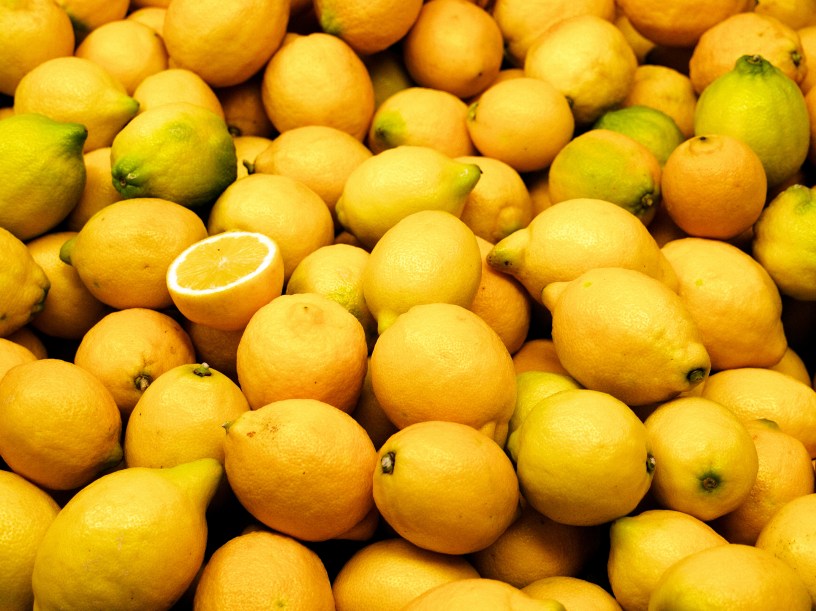
Cover photo credit: Lemons at the Mercat Central de València, Spain, © Hans Hillewaert / CC BY-SA 4.0
Reference:
Akerlof, G. (1970). A., 1970, The market for ‘lemons’: Quality uncertainty and the market mechanism. Quarterly Journal of Economics, 84(3), 488-500.
 Mereconomics