
(No bargain)
With Ukraine still very much top of mind and conditions deteriorating further, I will pivot a little to reinforce that bargaining spaces require mutual understanding of values across another important aspect of life that is dramatically under threat – our environment and federal lands, and the natural capital that provides myriad benefits to Americans and the globe. Not only is the language of environmental well-being being scrubbed from the federal government, but the science and skilled workforce protecting these resources are being decimated.
This is at least a space where some positive news can be reported. That is in part because the problem of public goods provision and need for collective action is well understood. It is also not just a federal management problem but one that state and local governments, international governmental and non-governmental organizations, and private enterprise have all got experience helping. So, some recent good news includes Hawaii Governor Josh Green’s executive order (Feb 18, 2025), Operation Hire Hawai’i. The governor is seeking to fast track employment across all sectors, including land and ocean management, just one of many areas in which the federal government’s capricious actions are opening dangerous chasms.
But global and national environmental problems cannot be completely solved at smaller scales. This is YOUR federal land. Joint ownership with your fellow Americans is an endowment bestowed and supported from the earliest days of the American Republic, through the 1785 and 1787 Land Ordinances. Just a couple of the many additional important milestones affecting you today include:
- the (1872) creation of Yellowstone as the first of the now 63 National Parks on 85+ million acres of land, where now your summer plans are under siege;
- the various Forestry acts creating the Forest Service at the end of the 19th / beginning of the 20th Century, which from its inception has had multiple mandates including timber and water supply, but are now targeted for more heavy extraction regardless of the costs;
- The Big Burn of 1910, which clinched the argument for funding Forest Service monitoring and enforcement activities (Timothy Egan’s book on this topic is wonderful), that apparently needs to be made now again in spite of the very destructive wildfires of recent months and years.
Without the science, monitoring, and enforcement of these lands and waters and their ecosystem services, you are losing value. These losses are often irreversible; claims that this natural wealth will be harvested/ mined/ captured/ drilled for your benefit cannot be trusted to generate superior or even equivalent value.
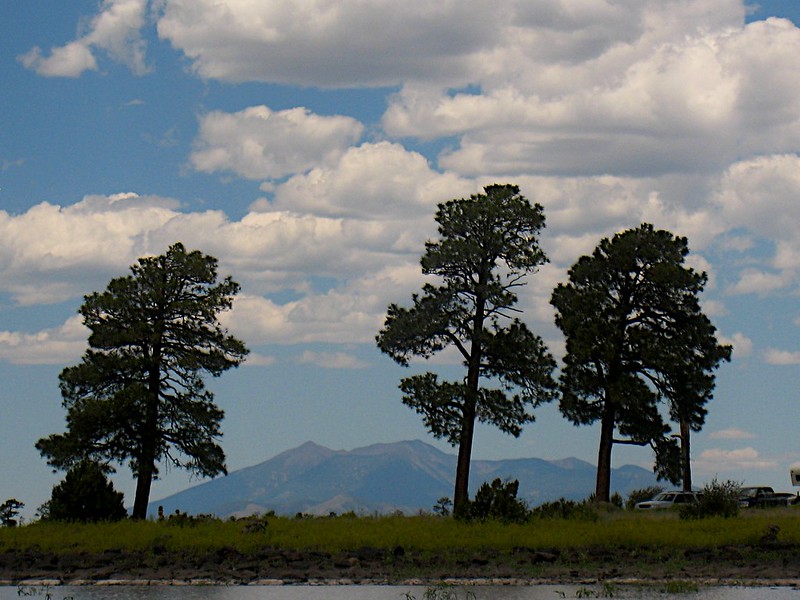
This value can be notoriously difficult to put in monetary terms. Natural and physical capital are highly imperfect substitutes, so that bargaining trades that aim to transform the former to the latter are subject to significant information problems and dynamic inefficiencies. This, as discussed with respect to mineral resources in the last post, leads to an inability to define and share bargaining spaces. Standoffs occur. The Bundy standoff (2014) is an example that moved into violence. More peaceful examples of standoffs when values cannot be reconciled for trade include people living up in tree canopies to stop logging, like the real Julia Butterfly Hill living in her tree Luna in the CA redwoods or some of the fictional characters in Richard Powers’ wonderful novel The Overstory. Today’s poem works for both cases:
Tree Sitting

Tree sitting,
I was tree sitting,
with my back toward the sun,
I was wearing a green shirt, the color
of the leaves, camouflaged.
I needed no sword to defend myself.
I became a tree and stayed out of the fray.
Eventually, I would become a ghost.
They took the fight to me
and without a sword I could not fight back.
The days would end for Luis Cuauhtémoc.
The sun shined inside my eyes
and the rain washed out the blood.

________________________
Luis Cuauhtémoc Berriozábal
Where does that leave us today? We can’t all live in a tree for more than 2 years, as much as we might like to (especially now). If courts and treaty violations and property rights ‘misunderstandings’ have been at the base of the lack of bargaining spaces, redress may also come from them (Much more to come on these topics moving forward, if the torrent of awful news can slow just a little for longer term thoughts). Lawyers and courts will be important, just as with other challenges underway to our democracy and well-being. As with much in the conservation realm, New Zealand has taken a lead, giving personhood to Taranaki Maunga / Mount Taranaki (2025), a river (Whanganui River, 2017), and a stretch of sacred forest (Te Urewera, 2014). These natural resources’ legal rights are intended to uphold its health and wellbeing, without eliminating public access.
Like Māori in NZ, Native Hawaiians (Kānaka maoli) have a sacred mountain: Mauna Kea. A 2019 standoff at Mauna Kea over decommissioning of telescopes gives an indication of how complex these questions can be, but also that solutions can be found with more inclusive processes. We know in the US what personhood for a corporation can do for evil, perhaps it is time to find out what it can do for good.
For more on the poet, see here
Cover image Credit: Alan Levine
 Mereconomics