

(Nothing about us without us)
We are hearing, rightfully, a strong refrain of “nothing about Ukraine without Ukraine.” This post discusses the absolute appropriateness of this demand indirectly, by sharing some insights from long run impacts of the differences in having a seat at the table vs. not. Indeed, understanding this better is a large part of what I’m doing here in Australia right now, so I’ll focus on the Pacific. Another day we’ll talk about Greenland’s 2024 Foreign Policy Strategy, “Nothing about us without us.”
Dreamtime
Oodgeroo Noonuccal

Here, at the invaders talk-talk place,
We, who are the strangers now,
Come with sorrow in our hearts.
The Bora Ring, the Corroborees,
The sacred ceremonies,
Have all gone, all gone,
Turned to dust on the land,
That once was ours.
Oh spirits from the unhappy past,
Hear us now.
We come, not to disturb your rest.
We come, to mourn your passing.
You, who paid the price,
When the invaders spilt our blood.
Your present generation comes,
Seeking strenght and wisdom in your memory.
The legends tell us,
When our race dies,
So too, dies the land.
May your spirits go with us
From this place.
May the Mother of life,
Wake from her sleeping,
and lead us on to the happy life,
That once was ours.
Oh mother of life,
Oh spirits from the unhappy past,
Hear the cries of your unhappy people,
And let it be so.
Oh spirits- Let it be so.
Australia has changed a lot since my first visit here 20 years ago (caveat: I think I have too). I remember being struck by how much it felt like Britain had been laid on top of an otherwise exotic, Pacific Island. The dissonance was obvious.
My visit so far in Sydney still involves British Street names, Victorian architecture and plenty of offers of fish and chips.

History House, 133 Macquarie Street, Sydney
Paul Hogan still gets a shout out on the harbor tour.
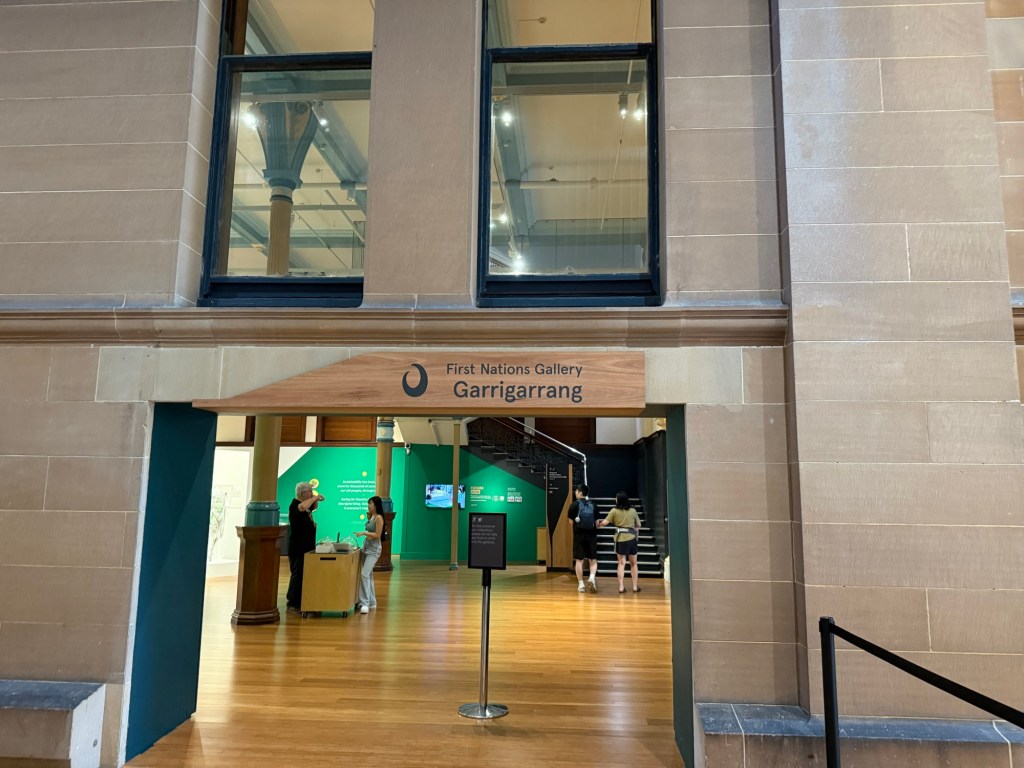
But every guide mentions Aboriginal names for places, every museum website and government building now stresses the co-sharing of land originally stewarded by Aboriginal and Torres Strait Islander peoples, on “paper” and with exhibits.

The Australian Aboriginal flag flies in many locations.

There is a ways to go, still, certainly. Just over a year ago, the country voted “no” to giving Aboriginal Australians and Torres Strait Islanders a voice in parliament through the constitution. Reasons people voted no were diverse and complicated, ranging from misinformation and racism to a desire to first have a treaty between Aboriginal and Torres Strait Islander peoples and Settler Australia before incorporating the matter into the constitution.
That’s right – there is and never has been a treaty between the original stewards of Australia (numbering upwards of 500 groups or tribes) and Europeans or settler Australians. This stemmed from Cook’s (and his influential travelling companion, Joseph Banks’) view that Australia “so far as we know doth not produce any one thing that can become an Article in trade to invite Europeans to fix a settlement upon it.” This became extended to Banks’ strong advocacy for a penal colony at Botany Bay, where he assessed that the Indigenous Australians present would give way to the British and were of little consequence. In later developments, the claim that Australia was “terra nullius” or devoid of land claims from existing humans, denied Aboriginal and Torres Strait Islander peoples a seat at the table and fed Australian decision-making and negated treaty opportunities.
This is in stark contrast to both New Zealand and Hawaii, other Pacific communities dramatically changed by European contact in the late 18th Century.
That’s right – both Māori NZ (Aotearoa) and Hawaii were recognized as sovereign entities in the early 1800s and treated with by European and American Nations. The extent of this recognition of New Zealand remains somewhat contested, but it did result in the foundational treaty for New Zealand, the 1840 Treaty of Waitangi, that still guides relations in the country today. (Note: once again language and communication challenges have played an important role in identifying the bargaining spaces between the groups and in establishing the framework of rights). In Hawaii, the Kingdom was recognized by many European powers over the century, becoming a constitutional monarchy and participating on the world stage. Eventually however, powerful American sugar interests’ betrayal led to the coup (1893) that brought Hawaii into the US as a territory in 1898 – under President McKinley, one of Trump’s current historical presidential idols (alongside Andrew Jackson and Warren Harding… ’nuff said).
Both of these recognitions were in large part due to Europeans squabbling with each other and trying to keep the upper hand, so still in essence trying to keep the decision-making at the European level and trying to maneuver the Pacific states as pawns in their 19th Century imperialist games. But the initial recognitions laid the groundwork for the seats at the table that are helping native communities in Hawaii and Aotearoa NZ negotiate land, sea and environmental conditions for their peoples today.
It should go without saying that Ukraine and Greenland must not be left out of the decisions about their futures. With centuries of identity in both communities, there is no other long term peace or prosperity. The poem, by Indigenous Australian writer Oodgeroo Noonuccal, makes this crystal clear.
Photo credits: Brooks A. Kaiser (c) 2025
 Mereconomics