
(The endangered north)
The US Environmental Protection Agency (EPA) has announced plans for massive deregulatory efforts, grant revocations, and firings (now blocked by judicial action) that attack climate and environmental justice concerns amongst other environmental threats. The aim of these changes is to support Trump’s backward-looking vision of a fossil-fuel and resource extraction-driven America with felled forests, poisoned waters and air, where those losses and poisons fall mainly in poor and Indigenous communities. Sure, resource extraction and use made America rich, but in our wealth, we should now be able to turn the corner and consume environmental and social well-being alongside economic ‘growth.’
This concept – that when we get rich enough, we stop destroying the environment from which we derive so much benefit and invest in it instead – is known as the Environmental Kuznets Curve (EKC). Empirical evidence for its existence is mixed; it is complicated by many co-factors, such as the ability to decouple production and environmental impacts (think lead in fuel or sulfur in coal); thus some pollutants show more evidence of the EKC than others.. Co-factors in favor of the EKC’s existence include, simply put, preferences for environmental goods and services. In terms of global pollutants like greenhouse gasses, there are few countries that can be shown to have turned the corner on CO2 emissions. The US’s intended gutting of the EPA strongly suggests we will not be able to act upon our preferences for cleaner environment, no matter how much we may desire them. Canada on the other hand may be one of the countries that has made the turn.
There is plenty of analysis available for how damaging and unequal the EPA deregulation and gutting can be expected to be. Today I want to more specifically connect this particular horror of the administration to the ongoing battles for for Canadian and Greenlandic sovereignty. It should go without saying that these countries, longstanding allies to the US, should not in any rational world have their sovereignty threatened by a predatory imperialist trying to live out some McKinley-esque fantasy (does he actually know how that presidency ended?). Yet here we are.
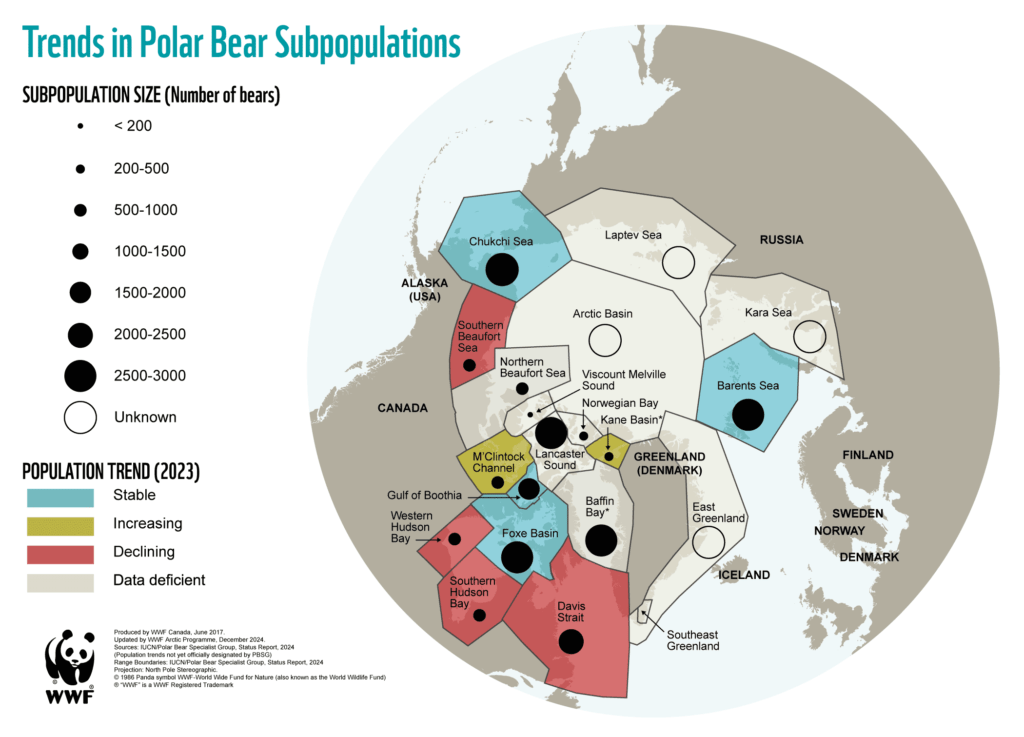
By virtue of their remaining grand open spaces, both countries hold positions in the world of not only resource abundance but also ecological value. Between them they share almost half the Arctic ocean coastline. They also host a majority of the remaining habitat for the iconic polar bear, for example. Charismatic megafauna often take on an outsized role in conservation discussion and debate, and here I make no exception for that.
When contemplating co-existence with polar bears, it is good to remember that humans are not always the top predator. It takes community, attention to surroundings, common sense and responsibility for success – the same skills it will take us to create better after-times, and sooner. The threats to Canada and Greenland are having one positive impact: they emphasize the great extent to which both locales have these characteristics going for them in our battle to keep them the free north.
The poet and the poem
Our poet, Allison Adelle Hedge Coke, has direct experience with the EPA, as he father was an early employee of the agency (started under Nixon!). She’s an Indigenous knowledge holder as well, and has lived in the US and Canada. You can listen to an excellent podcast with her about the depths of the poem and its relevance for where we have been and where we need to go by following the link in the title. She’s even used her poetry as a “secret weapon” in fighting for the environment; like the last line of the poem, she demonstrates we can find optimism to rebuild.
"When the Animals Leave this Place"
By Allison Adelle Hedge Coke

Underneath ice caps, once glacial peaks
deer, elk, vixen begin to ascend.
Free creatures camouflaged as
waves and waves receding far

from plains pulling

upward slopes and faraway snow dusted mountains.
On spotted and clear cut hills robbed of fir,
high above wheat tapestried valleys, flood plains
up where headwaters reside.

Droplets pound, listen.

Hoofed and pawed mammals
pawing and hoofing themselves up, up.
Along rivers dammed by chocolate beavers,
trailed by salamanders—mud puppies.

Plunging through currents,
          above concrete and steel man-made barriers

these populations of plains, prairies, forests flee
in such frenzy, popping splash dance,
pillaging cattail zones, lashing lily pads—
the breath of life in muddy ponds, still lakes.

Liquid beads slide on windshield glass

along cracked and shattered pane,
spider-like with webs and prisms.
“Look, there, the rainbow
touched the ground both ends down!”

Full arch seven colors showered, heed
what Indigenous know, why long ago,
they said no one belongs here, surrounding them,
that this land was meant to be wet with waters of nearby
not fertile to crops and domestic graze.

The old ones said,

“When the animals leave this place
the waters will come again.
This power is beyond the strength of man.
The river will return with its greatest force.”

No one can stop her.
          She was meant to be this way.
                         Snakes in honor, do not intrude.

The rainbow tied with red and green like
that on petal rose, though only momentarily.
Colors disappear like print photographs fade.
They mix with charcoal surrounding.

A flurry of fowl follow

like strands, maidenhair falls,
from blackened clouds above
swarming inward
covering the basin and raising sky.

Darkness hangs over

the hills appear as black water crests,
blackness varying shades.
The sun is somewhere farther than the farthest ridge .
Main gravel crossroads and back back roads

slicken to mud, clay.
          Turtles creep along rising banks, snapping jowls.

Frogs chug throaty songs.
The frogs only part of immense choir
heralding the downpour, the falling oceans.
Over the train trestle, suspension bridge with

current so slick everything slides off in sheets.

Among rotten stumps in black bass ponds,
somewhere catfish reel in fins and crawl,
walking whiskers to higher waters.
Waters above, below

the choir calling it forth.

Brightly plumed jays and dull brown-headed cowbirds
fly as if hung in one place like pinwheels.
They dance toward the rain crest,
the approaching storm

beckoning, inviting, summoning.

A single sparrow sings the stroke of rain
past the strength of sunlight.
The frog chorus sings refrain,
melody drumming thunder,

evoked by beasts and water creatures wanting their homes.
Wanting to return to clearings and streams where ash, or
white birch woods rise,    tower over,
quaking aspen stand against
storm shown veils—sheeting rains crossing

pasture, meadow, hills, mountain.
Sounds erupt.
Gathering clouds converge, push,
pull, push, pull forcing lightning

back and forth shaping
windy, sculptured swans, mallard ducks, and giants
from stratocumulus media.
As if they are a living cloud chamber,
As if they exist only in the heavens.

Air swells with dampness.
          It has begun.
The True North Strong and Free
The poem today leans on the listening we should be doing to nature and its seasons. For all the destruction we have seen and are seeing in the world, the poem eventually comes to suggest renewal can and will happen. Those renewals will need grounds to swell from – and Canada and Greenland are optimally situated to lead the way in sustainable, community-built change (alongside a re-invigorated Europe). Being sucked into the swirling drain of the US today is not an option we can allow, not just for the citizens of these countries, not just for their existential roles in supporting rules-based world order, but for the planet’s health and future as we come to rebuild when the MAGA flood is over.
Canada and Greenland both represent the intersections of past and future realms. With exceedingly low population densities (CA at ~4 people / km2 and GL at about 0.13 people/km2), we can still see and defend the landscapes like those described before the steel barriers in the poem. And by and large, Canadians and Greenlanders choose to do this, with some difficult exceptions. This is the forward-looking, sustainable development approach we will need to rebuild our damaged planet. It’s in line with EU ambitions and sensibilities that reflect care for humans and nature globally, not just for selfish domination. It is, however, at odds with the backward-looking approach of the current US administration and the fossil fuel industry.
It’s monetarily costly for these places – Greenlandic independence needs ways to make up any reductions in the Danish block grant, and the resource-rich countries face constant temptations to trade away their natural capital for cash that can fund everything from schools and hospitals to technology and other growth-oriented investments. Any decisions to transform this natural capital need to rest in local and community hands, along with their net benefits, rather than fund foreign oligarchy. Their willingness to forego these financial benefits for global ecological gain needs to be financially and institutionally supported by the rest of the world, not threatened by Trump’s imperialist whims. So far, at least, the threats of doing so have united Canada and Greenland against not just Trump’s aggressions but also against such market pressures – foregoing US products and travel, for example. But market pressures are real, and international support must be directed at alleviating these pressures not exacerbating them. Saving the polar bears now has a whole new dimension – sparing Canada and Greenland from US imperialist aggression. Let’s not have the polar bears need to leave their place.
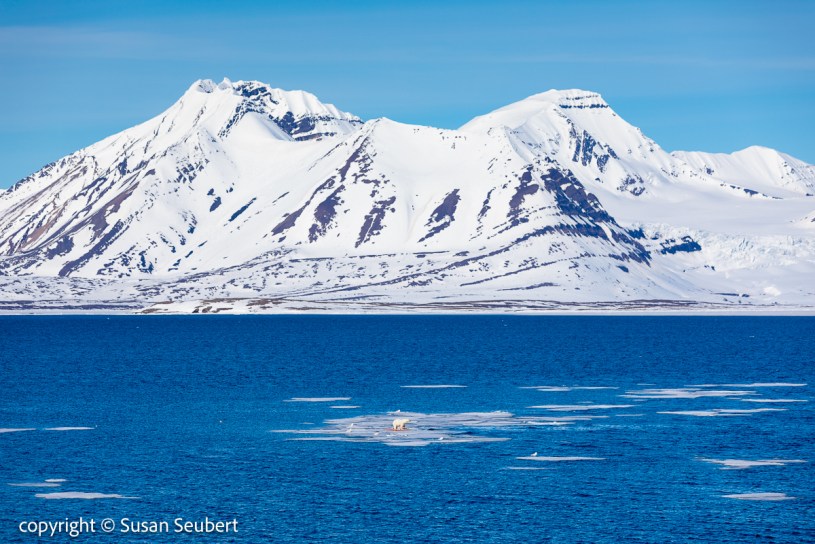
Photo description and credit (zoom in for detail): Polar Bear on the remnants of some fast ice in Svalbard that melted in front of photographer Susan Seubert over the course of a few hours, leaving the bear without anywhere to stash its kill. The “leftovers” from any kill are valuable to the individual animal, as well as to other animals that might be able to consume the carcass, from birds to other polar bears. The remnants of this meal sunk to the bottom of the ocean, where it will certainly feed some fish and become part of that ecosystem, but the vanishing ice is a tremendous problem and the waste of a perfectly good bearded seal has ramifications.
(c) Susan Seubert Photography, Inc.
www.sseubert.com; IG @susanseubert
 Mereconomics