
(Sunk costs don’t matter but generational transfer does)
One place where we will wittingly or unwittingly shape the after-times of the current traumatic transition is in how we engage with our technological future. The upheaval Trump and his sycophants and broligarchs are causing is in part due to the pace and concentration of industry, particularly the tech sector, moving faster than we can govern its social and economic consequences.
Part of the intensity of impact from the backlash against Musk, Tesla, and Starlink is that we have a billionaire whose products and work have shifted from things perceived to help the planet and its people (electric cars, starlink satellites connecting far-flung, sparse communities and war-torn Ukraine) to things he can wantonly destroy simply because he perceives them to be in his way. He seems to have a high school sophomore’s trust of crappy AI to “improve the world.” This combines with a misunderstanding of the economic truism that sunk costs don’t matter (the sunk cost fallacy). This is true when what will replace the existing system is in fact more efficient, with lower operating costs and equal or better output. It is NOT the case when it imposes real external costs (eg environmental or social, such as lost conservation management or telephone access to social security services).
We’ve been through this before, with the robber barons of the late 19th and early 20th Century. Worker conditions were terrible, while from this labor, fortunes were amassed in railroads, mines, oil, steel, sugar, etc. Vertical and horizontal integration concentrated new industries under a handful of powerful men who schemed for decades to get ever richer and become ever more untouchable. Sugar interests were even behind the coup that reduced the Hawaiian Kingdom to a US territory. (Well come back to this story again).
You know these names today: they are still on massive companies, but also on foundations, universities, land trusts and libraries in the US and around the world. Mellon in banking was perhaps the Elon Musk of his day, getting involved in politics with his fortune and supporting the Harding, Coolidge and Hoover administrations and getting himself impeached as Sec. of the Treasury, a process only stopped by quick appointment as Ambassador to the UK instead – and whose grandson is now a big supporter of the current president.
Andrew Carnegie has a more positive philanthropic legacy, giving away almost 90% of his fortune in the latter portion of his life, despite being known for his hard-driving of labor. A famous story demonstrating how sunk costs don’t matter is the credit he is given for having made his steel fortune by continually renewing technologies for steel production even when existing technologies were still quite functional. I’m sure the robber barons sitting around praying to the Project 2025 manual and Ste. Ayn think this creative destruction and hard-driving is part of the American gospel.
But realizing sunk costs don’t matter is not enough – one must have the vision and imagination for what replaces the existing systems and technology. We can definitely do better here than we are doing now (suggestion: read the whole book)! Elon Musk is now out there trying to keep Tesla going by promising it will bring about a Star Trek Economy without scarcity – seems more bread and circuses to me. But this is narrative we must engage with and guide.
Each robber baron’s legacy story for how their fortunes came to the public sphere is a little different, but they paint a picture of their future-world building. Some just wanted their egos stroked or a place to leave their art collection (Mellon), others became more public minded and were explicitly trying to avoid heirs becoming ‘intoxicated with power‘ (Rockefeller, whose foundation has now divested from fossil fuels altogether), and some, like Carnegie who came from a poor background, wanted to create conditions for others like those that had helped him gain the knowledge he needed to get ahead, and so invested heavily in building community libraries in the US and elsewhere, where those communities committed to maintenance and operations.
Libraries and librarians are now on the figurative and literal front lines of the battle for democracy. The Haskell Free Library in Vermont and Quebec, for example, is a physical symbol of 120 years of Canadian and American cooperation under siege since DHS Secretary Kristi Noem pulled a stunt jumping back and forth across the taped border line in the building with demeaning comments to Canada. (You can donate here to changes needed to the building to accommodate this wasteful battle, but they’ve already got more than needed). The institute of Museum and Library Services is being DOGEd, it certainly isn’t about the small amount of funding involved, but that little money goes a long way in smaller, rural libraries where you might find just the type of person who really needs that library to move themselves beyond the existing limits.
We need comprehensive and compellingly inclusive visions of the 21st century equivalents of the Sherman Antitrust Act, the multi-asset-oriented Forest Service (as opposed to the drill-baby-drill, Heigh-ho off to the mine we go plans in progress), Product Safety Legislation, and so on (see section 5 here for some of my past preliminary thoughts on the issue, before e.g. AI was a force to be reckoned with). It’s too late to stop the agglomeration of wealth by the broligarchs (although market corrections are underway that have some impact perhaps), but I hope we can still get them to become Rockefeller and Carnegie philanthropists over Mellon types. Examples of hope include Bloomberg’s climate finance promises and Gates’ support for public health and other causes. These efforts reach beyond the individual bro, because they have the empathy and imagination to see better things for the many, not the few.
So today’s poem is for the libraries and librarians, who help us have empathy and imagination, too.
Because of Libraries We Can Say These Things
by Naomi Shihab Nye

She is holding the book close to her body,
carrying it home on the cracked sidewalk,
down the tangled hill.
If a dog runs at her again, she will use the book as a shield.

She looked hard among the long lines
of books to find this one.
When they start talking about money,
when the day contains such long and hot places,
she will go inside.
An orange bed is waiting.
Story without corners.
She will have two families.
They will eat at different hours.

She is carrying a book past the fire station
and the five and dime.

What this town has not given her
the book will provide; a sheep,
a wilderness of new solutions.
The book has already lived through its troubles.
The book has a calm cover, a straight spine.

When the step returns to itself,
as the best place for sitting,
and the old men up and down the street
are latching their clippers,

she will not be alone.
She will have a book to open
and open and open.
Her life starts here.
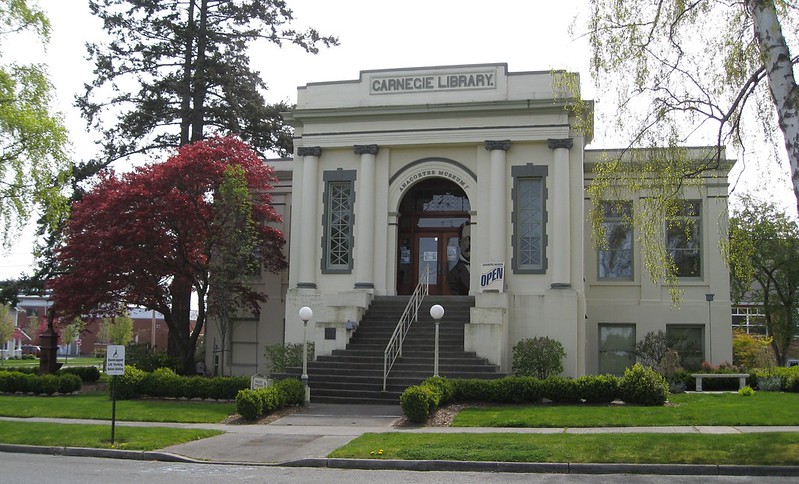
Cover Image Credit: “Carnegie Library – Anacortes, Washington” by brewbooks is licensed under CC BY-SA 2.0.
 Mereconomics