
While the focus has rightly been at the federal level for much of the dismay about the future those in power are trying to build, several states are contending for runner up in the Miss ‘Murica pageant for most dystopian vision.
Never to be outdone in such competitions, Florida is contemplating or already enacted a couple of beggar-thyself changes that need attention.
First, the state wants to loosen child labor laws so teens can work overnight at their dead-end fast food joint jobs. The argument is apparently that they’ve deported all the immigrants who have been filling this job so they need the children. Though there are surely benefits to working some during high school, there is pretty clear evidence that working too much while trying to get schooling causes lifetime losses in education and the income that correlates with it.
But perhaps it won’t matter much, because the second area where Florida thinks it needs reform is property taxes. Property taxes fund schools, roads, other local and community services. In Florida where there is already no income tax, property taxes are quite important for good schools and prosperous communities. Homeowners are also struggling with insurance rates that have risen significantly in recent years to cope with increasingly damaging storms. Many can’t or won’t insure at all, as companies can’t make the math work and are pulling out of the state. Up to 20% of property owners are currently foregoing insurance policies altogether.
The self-inflicted tragedies will pile on top of the increasing risks of climate change, which regardless of continued funding or not, are not allowed to be discussed in Florida schools, or in any state laws or planning.
The combination of these policies and decisions is not just reprehensible for the children, families, and homeowners it will affect directly. It’s also set to exacerbate income inequality in structural and intergenerational ways. Reduced education and more fragile housing for the poorest while the well-off continue to insure or can handle losses without the spiraling impacts of losing one’s only asset (home).
The true cost of living in a hurricane zone swampland is high and rising, but poor communities can’t, and rich communities won’t, pay the current cost let alone the investment costs in education, infrastructure and research to create resilience and lasting prosperity.
Is it any wonder that Florida Man is shorthand for an individual exhibiting idiotic decision-making? So for our poem today, we focus on Florida without the man- a complex set of fragile interdependent ecosystems with beauty and decay. Let your imagination visit this Florida!
Florida
Elizabeth Bishop

The state with the prettiest name,
the state that floats in brackish water,
held together by mangrave roots
that bear while living oysters in clusters,
and when dead strew white swamps with skeletons,
dotted as if bombarded, with green hummocks
like ancient cannon-balls sprouting grass.
The state full of long S-shaped birds, blue and white,
and unseen hysterical birds who rush up the scale
every time in a tantrum.
Tanagers embarrassed by their flashiness,
and pelicans whose delight it is to clown;
who coast for fun on the strong tidal currents
in and out among the mangrove islands
and stand on the sand-bars drying their damp gold wings
on sun-lit evenings.
Enormous turtles, helpless and mild,
die and leave their barnacled shells on the beaches,
and their large white skulls with round eye-sockets
twice the size of a man's.
The palm trees clatter in the stiff breeze
like the bills of the pelicans. The tropical rain comes down
to freshen the tide-looped strings of fading shells:
Job's Tear, the Chinese Alphabet, the scarce Junonia,
parti-colored pectins and Ladies' Ears,
arranged as on a gray rag of rotted calico,
the buried Indian Princess's skirt;
with these the monotonous, endless, sagging coast-line
is delicately ornamented.

Thirty or more buzzards are drifting down, down, down,
over something they have spotted in the swamp,
in circles like stirred-up flakes of sediment
sinking through water.
Smoke from woods-fires filters fine blue solvents.
On stumps and dead trees the charring is like black velvet.
The mosquitoes
go hunting to the tune of their ferocious obbligatos.
After dark, the fireflies map the heavens in the marsh
until the moon rises.
Cold white, not bright, the moonlight is coarse-meshed,
and the careless, corrupt state is all black specks
too far apart, and ugly whites; the poorest
post-card of itself.
After dark, the pools seem to have slipped away.
The alligator, who has five distinct calls:
friendliness, love, mating, war, and a warning—
whimpers and speaks in the throat
of the Indian Princess.
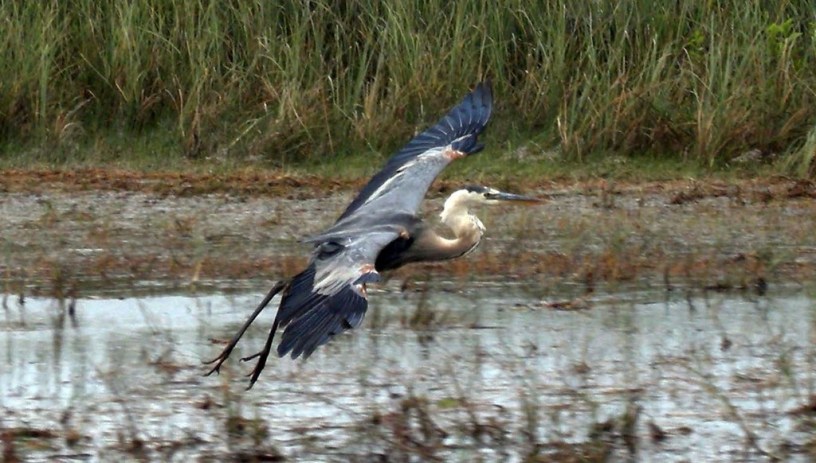
Cover image credit: “Bird in the Everglades” by milan.boers is licensed under CC BY 2.0.
 Mereconomics
and now a new affront:
https://apple.news/AZvkzCg84TZ-UAqcA8MXorg
LikeLike