

(Effective Case Studies and Model building)
Some of you may have noticed I’ve embraced the TV show Andor quite thoroughly. If you have not watched through Season 2, you should stop here and go do that before coming back. I will be discussing it and other Star Wars movies.
… space to exit before spoilers…
…
and a poem about our current world…
What Kind of Times Are These
By Adrienne Rich
(written in 1991)

There's a place between two stands of trees where the grass grows uphill
and the old revolutionary road breaks off into shadows
near a meeting-house abandoned by the persecuted
who disappeared into those shadows.

I've walked there picking mushrooms at the edge of dread, but don't be fooled
this isn't a Russian poem, this is not somewhere else but here,
our country moving closer to its own truth and dread,
its own ways of making people disappear.

I won't tell you where the place is, the dark mesh of the woods
meeting the unmarked strip of light—
ghost-ridden crossroads, leafmold paradise:
I know already who wants to buy it, sell it, make it disappear.

And I won't tell you where it is, so why do I tell you
anything? Because you still listen, because in times like these
to have you listen at all, it's necessary
to talk about trees.
...
…
…
…
You might think, with this poem and your knowledge of Andor already, I am planning to say something about the parallels between the current events in L.A. and the Ghorman plotline of false flag operations and distraction that lead to massacre of peaceful protestors, but I think the poem speaks for itself, and the Empire’s betrayal of, lies about, and violence toward the Ghor are being well covered within the meme world, as summarized here:

Besides, this is an economics (and the arts) blog at heart, so my focus will be a little different. I want to talk about how great the show is at capturing the essence of building a model from case studies. This is a tricky task in academia and one that can easily go wrong, leading theoretical development astray or ‘reaching’ to incorporate every detail of the cases into a comprehensive model, and instead ending up with a mess of math no one needs or cares about.
Models are not meant to capture every aspect of the world. They are meant to get at the heart of the narrative in relevant ways that assist accurate analysis and predictions. They should help differentiate between alternative causalities. In season 1, Vel says, “Everyone has their own rebellion.” If that’s true, there’s a high likelihood that no number of case studies will be enough to build a reasonable model, because there will be too much idiosyncrasy and variation to distill into a model.
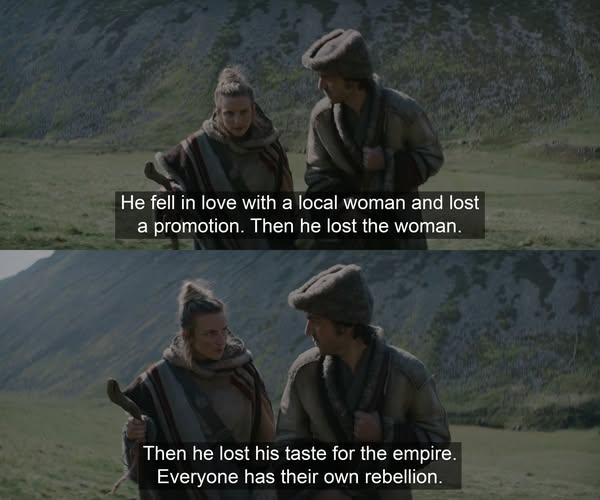
The idea that rebellion is personal is certainly borne out by the many different characters we meet, each with their own reasons for enduring the hardships of rebellion. Everyone has their own rebellion.
But what about rebel leadership? Season 1 is itself a detailed case study in how Cassian Andor moves from talented miscreant to active rebel leader. Screen titles identify his home planet as Kenari; his adopted one as Ferrix. We see the sister he leaves behind, and the confusion and anger Cassian goes through. The whole show starts with him searching for his sister on Morlana One, also identified by screen titles. Throughout the show, new planets and places are identified with screen titles: Aldhani, the Maltheen Divide, Coruscant, Ghor, Mina Rau, Chandrila.
The case studies build along various dimensions of rebellion. The role of intergenerational relationships is one important narrative. Cassian is not the only key character with intergenerational trauma. Dedra Miro, the highly effective but deeply flawed ISB agent, had parents that were ‘criminals’ and she was raised in an orphanage. Cyril Karn, the first to chase Cassian Andor, has a mother is a whole case study in herself, and a father disappeared, an adventurer. Not present on screen, but lurking in the story-to-come, Luke and Leia Skywalker are the “original Star Wars orphans” and Jyn Erso is motherless with a potentially traitorous and absent father, also abandoned by her adopted warrior-father figure, Saw Gerrera. You would be forgiven for assuming this was a Disney story (oh wait…it is). Or that lineage is the key to rebel leadership, instead of some other set of traits.
At some point over the two seasons, prognosticators put forward Dedra as somehow, some way Cassian’s missing sister, as well as the more likely Kleya, Luthen’s highly capable assistant. And I imagine, in a Disney-Star-Wars world where bloodlines are generally connected and revealed at just the opportune moment, the pressure to make that true was significant. If Tony Gilroy had done this, we’d have another family case study to match the Skywalkers and Palpatines — the Andors (to be continued with the now fatherless baby with Bix on Mina Rau, and aunty Kleya). Lineage would be the ‘model’ – but limited in its usefulness, as shown by the reception to the sequel movies’ repetitive and improbable plot taking Rey from the universality of the force and placing her in within the Palpatine line.
Instead, Kleya’s (and to some extent Luthen’s) backstory is what transcends from case study to model. Suddenly, 22 episodes in to a 24 episode series, there are no planet names given, though they start on one and visit at least two more that are not ones already portrayed in the show (though one is now acknowledged to be Naboo from the prequels). The atrocities that drive Luthen to abandon his post and take on Kleya as a partner don’t have a name and it’s not clear who he’s fighting for or against, only that it’s horrific and beyond the pale. And surprise – Kleya is not Cassian’s sister! She could be anyone’s sister in the face of violence and trauma. Bingo – we have a model for rebel leadership instead of just another case study.
Luthen even refers to his revelation the day he discovers stowaway Kleya as driving an equation – a model? – in his haunting speech on what he has given to the rebellion:
Lonnie (The ISB double agent): “And what do you sacrifice?
Luthen: Calm. Kindness. Kinship. Love. I’ve given up all chance at inner peace. I made my mind a sunless space. I share my dreams with ghosts. I wake up every day to an equation I wrote 15 years ago from which there’s only one conclusion. I’m damned for what I do. My anger, my ego, my unwillingness to yield, my eagerness to fight. They set me on a path from which there’s no escape. I yearn to be a savior against injustice without contemplating the cost and by the time I look down, there’s no longer any ground beneath my feet. What is my sacrifice? I’m condemned to use the tools of my enemy to defeat them. I burn my decency for someone else’s future. I burn my life to make a sunrise that I know I’ll never see. the ego that started this fight will never have a mirror, or an audience, or the light of gratitude. So what do I sacrifice? EVERYTHING.”
The monologue highlights the mechanisms that affect the model and are illustrated throughout: an ability to find calm, kindness, kinship, or love drives rebellious activity to success, and to ‘be worth it.’ Much of season 2 focuses on love and friendship. Bringing Bix back from her trauma. Healing the breach between Vel and Cinta. The tight-knit relationships amongst the Ghor and Ferrix survivors. And so on. The passcode for Luthen’s network is literally, “I have friends everywhere.” Failure to embrace these core attributes results in one’s doom – from Cyril and Dedra to Steen.
Avoiding wasteful doom – as opposed to making a meaningful sacrifice – means making peace with the rebellion as a group effort and joining its growing structure and forces. The one other time a planet is not (at first) identified with a screen title is at the beginning of season 2, when Cassian is captive after trying to hand over a stolen ship. This planet turns out to be Yavin 4 (a moon, actually) – the home of the rebel base by Rogue One and Star Wars. In BBY 4, it’s just a man-eating jungle with dysfunctional rebels and some abandoned temples. Luthen’s efforts to connect all the various rebellious factions push forward the rebel base, and this provides a refuge for Kleya after he’s gone. But his equation doesn’t include him getting there, having given up the essentials needed ‘long ago.’ Saw and Luthen thus define some boundary conditions for the model – they are willing to give their all, and they do so in ways essential to the rebellion’s success, but without these characteristics at their core, their flaws overshadow them and their legacies.
So, as we protest the coming atrocities of our own galaxy and time’s wanna-be emperor, remember the lessons of the model. Stick together, in calm, kindness, kinship and love. May all our rebellious case studies drive forward a model of successful resistance leadership. We have friends everywhere.
 Mereconomics