
With that title, you might expect Robert Frost’s poem The Road not Taken for today, as the topic is the administration’s decision to revoke the 2001 Roadless Rule. And that would have been a good one, with a focus on path dependence and road building, and you can refresh your memory on it here.
But for connecting the roadless wilderness to our needs, I turn to Yeats:
The Lake Isle of Innisfree
By William Butler Yeats

I will arise and go now, and go to Innisfree,
And a small cabin build there, of clay and wattles made;
Nine bean-rows will I have there, a hive for the honey-bee,
And live alone in the bee-loud glade.

And I shall have some peace there, for peace comes dropping slow,
Dropping from the veils of the morning to where the cricket sings;
There midnight’s all a glimmer, and noon a purple glow,
And evening full of the linnet’s wings.

I will arise and go now, for always night and day
I hear lake water lapping with low sounds by the shore;
While I stand on the roadway, or on the pavements grey,
I hear it in the deep heart’s core.
The poem longs for an idealized wilderness, still however tamed by man with a cabin and vegetable garden and busy bees producing honey. From the road, it isn’t attainable – except by listening. Wilderness areas have been a mandate of the National Forests and other public land management agencies since the Wilderness Act of 1964. For the purposes of the act, wilderness is defined as an area of federal land in their natural, undeveloped state. Roadless areas are thus prerequisites for new wilderness areas. There are currently 803 designated wilderness areas in the National Wilderness Preservation System covering 111 million acres, shown in the map here.

Inventoried roadless areas following the 2001 Roadless Rule are shown below. Note that these almost all surround existing wilderness areas – our options for wilderness are limited. I’ve also included the land areas of major US cities – the “pavements grey” we stand upon to listen to the wilderness. The western cities benefit from close proximity to these areas, while the eastern cities have few wilderness or roadless areas in which to find their Innisfree.

If roadless areas are opened up to extractive activities, the change is irreversible. We have long ago discussed how such land use values have played out in congressional votes since 1900 here and here, showing how such areas increase their role in preserving wilderness values with urbanization There is plenty of other evidence that these areas give immense value to people across many dimensions, some of which are synthesized here. A key finding is that these values generally exceed any commercial values from resource extraction on these lands.
Revoking the roadless rule is not just theft from the American people to the billionaire extractivists, but also makes the overall value of the resource lower and its future potential values more limited. Roads are also avenues for increased invasive species infiltration (very expensive!) and fire (devastatingly expensive!). Another lose-lose proposition from this administration.
You can take action to protect National Forest Roadless Areas here. There you also see more supportive information on how valuable the areas are to Americans. Once you put in your address it will show you your congressional representatives (these should already be on your speed dial) with a draft letter ready to go, or be edited if you want to make it more specific or personal. For example, you might want to change “public land hunter and angler” to “public land enthusiast” or “supporter” or “recreationalist”.
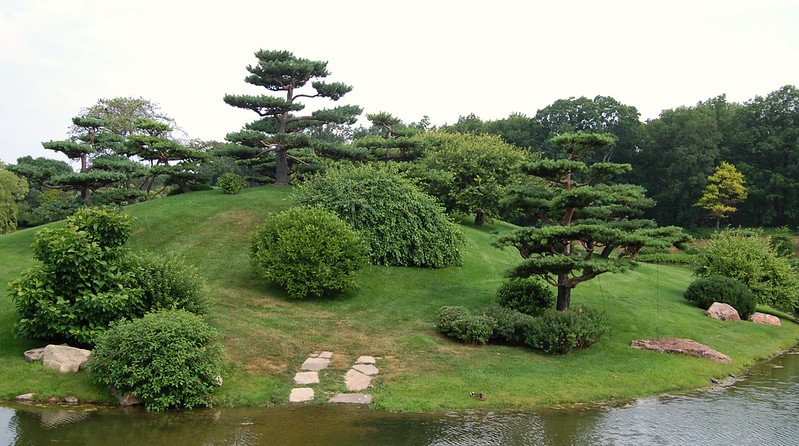
Normally I would just give the cover image credit, but I want to call your attention to the photo because it is Horaijima – a typical part of a Japanese garden that is made to be inaccessible to visitors, to be beyond mortal reach and meant to be appreciated from a distance. This one is at the Chicago Botanical Garden, I remember seeing it for the first time some 25 years ago. It seemed fitting for this post and the recognition that wilderness is also a state of contemplation and being. Making space for it needs to be intentional.
Cover image: JR P. Horaijima – The Island of Everlasting Happiness at the Chicago Botanic Garden – The Japanese Garden (Garden of Three Islands). A handwritten, sign says: “Horaijima is intended for use by immortal spirits only, though our staff has dispensation to keep it looking flawless. No crossing/wading is allowed – dropoff is steep.”
 Mereconomics