

My feed today included a travel story aimed at inducing me to go to Norway for a King Crab Safari – shown in the photo here.
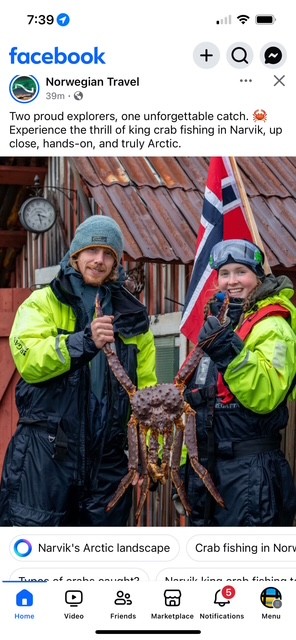
It’s not surprising such an ad showed up in my feed. I have researched the Red King Crab invasion in Norway and its growing use in the tourism industry for over a decade (see many previous blog posts), and I travel a lot, also to Norway. There are crab safaris in northern Norway, and they have created significant and growing opportunities for small communities in the north, attracting global tourists.
What was surprising is where in Norway it suggests I go – Narvik.
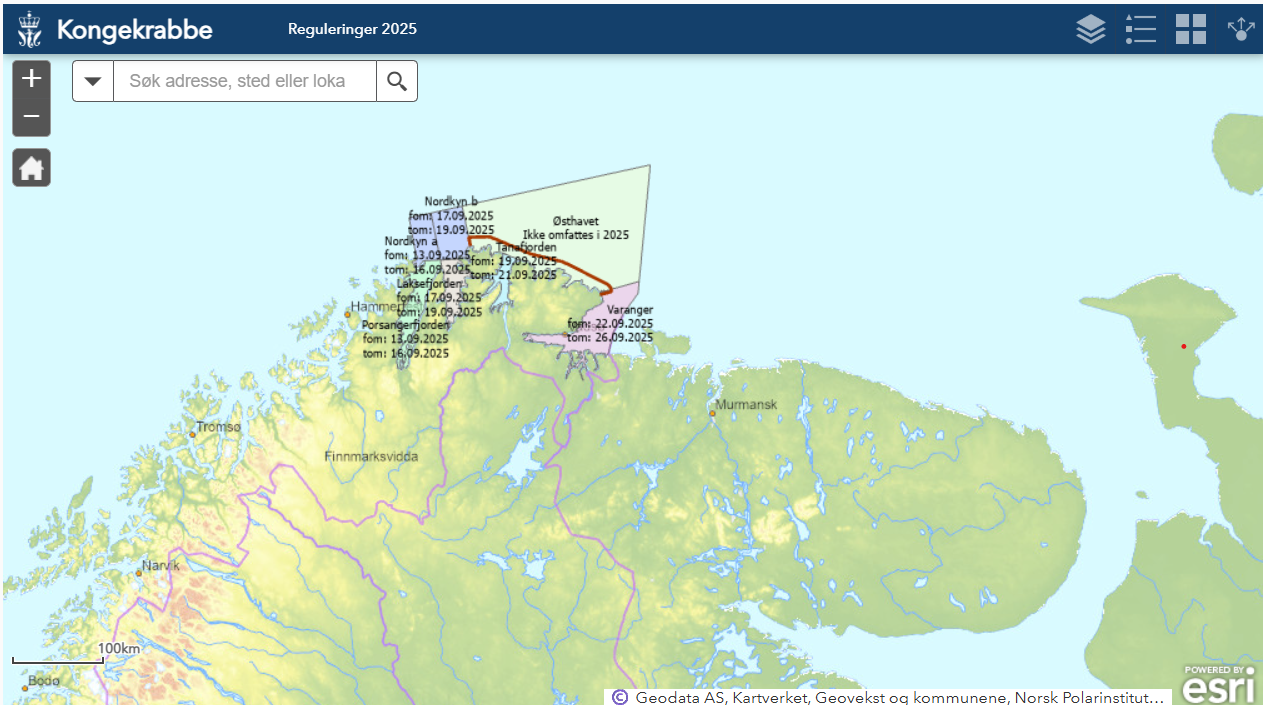
Unless I have missed a huge development of the spread of the crab in the last months (in the world of the possible, but highly unlikely), Narvik is pretty far south of the currently understood frontier of the crab invasion. So I ask:
- Did I, in fact, amidst distractions and other work foci, miss a massive shift in the range of the crab? (short answer: no, no, I have not).
- Did AI generate the whole thing, just matching a photo of a crab safari further north with the town of Narvik, which is a tourist destination for other marine activities but not King Crab safaries? (short answer: yes, I think so)
The questions of interest to me here are then:
- What does this sort of ad do to the tourism industry?
Does it, say, increase incentives to move the crab to Narvik (explicitly banned), in order to meet tourism demand and diversify tourism experiences in the area? In other words, if AI hallucinates that there are king crab safaris in Narvik, will this manifest red king crab safaris in Narvik? How long would this take? Who would be the players involved?
This would be bad as it would assist the spread of the invasion in ecologically fragile places with other valuable (cod) fisheries. As shown in the map, surveying for the crab doesn’t extend very far west. So scientific research may be behind AI-driven enterprise. This is a whole new dimension of bio-economic concern for invasive species!
2. Does it reduce trust and capabilities in tourism planning if AI fills plans with non-existent opportunities, leading to disappointments and frustrations for all? Have you used AI to plan a trip to a place you don’t know, and been excited by the idea of activities that turn out to be nowhere near or otherwise not real? This is a whole new dimension of concern for tourism, perhaps particularly for nature-based activities where the experience is dependent on the resource base.
Is there a poem for all this? Maybe:
Out Beyond Ideas of Wrongdoing and Rightdoing - Rumi

Out beyond ideas of wrongdoing and rightdoing,
there is a field. I’ll meet you there.
When the soul lies down in that grass,
the world is too full to talk about.
Ideas, language, even the phrase “each other”
doesn’t make any sense.
The breeze at dawn has secrets to tell you.
Don’t go back to sleep.
You must ask for what you really want.
Don’t go back to sleep.
People are going back and forth across the doorsill
where the two worlds touch.
The door is round and open.
Don’t go back to sleep.
Stay awake. Know where you are and where you want to go in time and space. Travel with intention.
 Mereconomics
Hi Brooks, This blog post really hit home as this is something I have been trying to explore (forgive the pun) but met with basically blank stares from all of my clients. If there is a way to do a deep dive with this idea I would be very interested. Of course, the number one problem with all of my projects is that they require money I do not have, sadly, as I think it would be very compelling to do a piece about AI generated travels and how they are inconsistent with reality. Anyhoo, hope all’s well with you in this mad, mad world. xo -Susan
Susan Seubert Photography, Inc. +1-503-819-6692 mobile susan@sseubert.com http://www.sseubert.com IG @susanseubert
NOTICE: This email may contain material that is confidential, privileged and is for the sole use of the intended recipient. Any review, reliance or distribution by others or forwarding without express permission is strictly prohibited. If you are not the intended recipient, please contact the sender and delete all copies.
LikeLike
Your advantage in doing some deep diving in this is that you know what’s true – you are able to locate yourself in the time and space possible. So yes, worth doing. It’s going to get harder and harder to fight against all this misinformation, and lots of negative impacts should be expected. The couple I mentioned, but also people being lost/stranded, or injured/causing injury, and so on. All the more reason to focus on trying to get people to talk to each other IRL!
LikeLike