
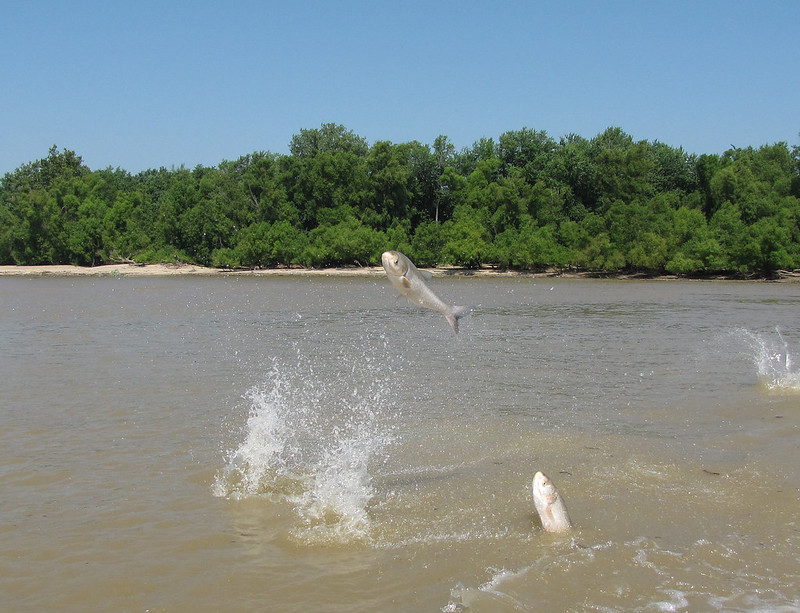
One part of yesterday’s (Monday, Aug 25, 2025) oval office press conference focused on a core of my research: aquatic invasive species. He definitely muddied the waters, confusing Michigan governor Gretchen Whitmer with someone named Kristi Whitman (perhaps he was thinking of the former governor of NJ and head of the EPA, Christine Todd Whitman, but who really knows?). But he’s right there is an ongoing invasion of a number of species of Asian Carp (not known as ‘China Carp’ as he called them) that is headed toward the Great Lakes.
There is some pretty sensationalist video of them jumping in to boats, too. The videos combine truth and experts with dramatic presentation, music and footage: the new mixed media. Here’s a long example:
It sounds like he wants to use this ‘foreign invasion’ to send the National Guard to Chicago to fight the fish, against Gov. Pritzker’s clear message that troops are not needed or welcome in Chicago. I guess he pictures them out on the water with bats and crossbows, like some of the video. The violent language of invasion has itself been a long discussion in academia, such as here (Words matter: a systematic review of communication in non-native aquatic species literature) and here (Does invasive species research use more militaristic language than other ecology and conservation biology literature?). We’ve worried about bias in decision-making from this language, but no invasive species scientist or policy-maker I’ve met in 30 years would have imagined this scenario.
The poets have a handle on the carp’s essence as an invasive species:
Asian Carp
Fleda Brown

are slipping through, as the lamprey did,
and the zebra mussels, the Irish, the Mexicans,
through holes in the fence, upsetting our delicate
craft, carp huge and leaping, taking jobs
as dance instructors, flinging their scarves
of water, displaying how far even the awkardest
gesture can go,
how their scarves are made of tears,
carp dressed for a blind date with history,
accompanied by circus music, slosh and oompah,
each and each, upward spikes, the neighbor’s
radio or their fighting, who can tell?
O world that does not know holy from
unholy, that provides no fabric labels, here is
tender flesh flying headlong into the boat,
here is the breeze carrying even the tiniest
GMOs gently across, an exultation of fittingness:
carp the size of rowboats, dinosaurs exactly
high enough for the branches, pterodactyls
measured for their sky. Then observe the random
irresponsibility of barriers, how our DNA climbs
its own spiral staircase for good or ill, how
the vast interior can turn inside out like a shirt,
how glaciers come and go, the molten lava,
molecular dust, how the hems of the Great Lakes
unravel.
Observe, then, what comes from the pit
of hopelessness and rises on its own like a cork,
springs even an inch or two above the surface
as if with joy, released from what appeared
to be everything but wasn’t the half of it.
As emphasized in the poem, the carp are part of a long progression of ecological and social change in the Great Lakes; it presents as a spectacle dampened by a greater understanding that eventually breaks through the surface.
No matter what kernels of truth trickled out in the bizarre performance yesterday, military brawn alone is not going to solve this long-unfolding (almost 20 years!) problem. Invasive species challenges are often at heart information problems, coordination problems and weakest-link problems. Rather than send in troops to swat futilely at adult carp (I am sure he would LOVE the visuals of this), they should bring back scientists and smart policy makers to EPA, FWS, and ERS, and restore NSF and other funding to universities and organizations, so the ecological realities and multi-jurisdictional governance problems can be solved and minimize negative impacts from the carp rather than create some new blood sport in seizing the carp.
The good news is, as of May there haven’t been any bighead or silver carp captured or observed in the Chicago Area Waterway during the semi-annual intensive monitoring effort, so extensive efforts to stop the spread down the line are holding for now. There wouldn’t be any fish-batting or shooting for troops to do, and they don’t need to be there.
 Mereconomics