

Stephanie McWhinnie (University of Adelaide), who participated via skype, started off the second day with her talk on International Fisheries Access Agreements and Trade. Using a global panel dataset, she empirically approached the question of why countries sign fisheries access agreements and compared these with countries’ characteristics that choose the path of international trade. Her results pointed to two key motives for access agreements and fish exports: a pattern of comparative advantage in fishing, which depends on fish stocks and fishing capacities, and gravity factors of economic size and distance. Her results provide evidence that of two things. First, gravity factors work similarly for agreements and exports – that is, larger countries that are closer to each other are more likely to sign access agreements or to participate in trade. Second, patterns of advantage are determined differently – source countries with larger fishing capacity are more likely to export fish, while source countries with lower fishing capacity are more likely to sign agreements.
Next, Xiaozi Liu (University of Vigo) presented her work on management solutions for shifting trans-boundary fish stocks under fixed catch shares (FCS). Recognizing the poleward shift of many fish stocks due to rising water temperatures, her work looks at adaptation strategies to avoid over-exploitation and rent dissipation. Xiaozi provided quantitative evidence for the necessity of those strategies and further demonstrated how FCS schemes can serve as a practical solution for minimizing impacts in transboundary stocks. She addressed those issues using a two players’ noncooperative model in which both players share a fish stock that moves from the EEZ of one country to the other due to increased water temperature. She further explained the process of identifying closed-loop Nash strategies where players periodically adjust harvest policies according to stock levels. Given that over-exploitation is at its most intense when two players have similar stock share, she proposed the FCS scheme which involves annual negotiations until one of the countries opts out. Xiaozi explained the analogies with quota negotiations in the EU common fisheries policy and effectively demonstrated how the proposed adaptation policy accounts for the stability of a coalition, assuring the sustainability of the shifting stocks and the rent from fisheries.

Miguel Peña Castellot (DG MARE, Economic analysis unit, European Commission) followed next with his presentation on ‘’EU’s international agreements: SFPA and Northern Agreements’’. Miguel first explained the historical origins of SFPAs from the first Community Fisheries Agreement in 1977, through the creation of EEZs in the 1980s in the context of UNCLOS, to the Fisheries Partnership Agreements (FPAs) in 2002 that were dedicated to support national fisheries sectors. In 2014, the Common Fisheries Policy reform replaced FPAs and led to SFPAs as we know them today. He went through the basics of their structure, principles and content, presented facts and figures and highlighted the associated economic benefits as well as their importance for fisheries governance globally. He used several examples of success stories from Africa, the Indian Ocean and the Pacific Ocean, such as from Sao Tome e Principe, Mauritania, Côte d’Ivoire, Guinea-Bissau, Seychelles and Kiribati to demonstrate the gains for partner countries from SFPAs. He concluded by discussing details, implications and outcomes from the agreements with Norway, the Faroe Islands and Iceland.

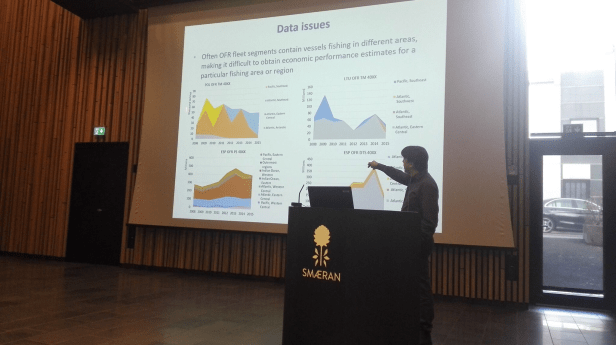
After the morning coffee break, Jordi Guillen (Joint Research Centre, European Commission) presented the main economic trends and indicators on the economic performance of the EU external fleet in different RFMOs. The data used for the analysis comes from the EU Data Collection Framework and the methodology focuses on the allocation of the economic activity of the different fleet segments to the RFMOs. Jordi discussed the latest developments on capacity, employment, landings and socio-economic indicators as well as the limitations of the data available. In this context, he concluded by bringing up recommendations for further improvements in the data collection process and the socio-economic analysis of the EU external fleet.
Timothée Brochier (Institut de recherche pour le développement) followed with his presentation ‘‘Competition or Cooperation in Transboundary Fish Stocks Management: Insight from a Dynamical Model’’. The model he presented is associated to an idealized system of a shared fish stock with different EEZs, in which the cost per unit fishing effort depends on local fishery policy. The model utilizes parameters from small pelagic fisheries shared between Southern Morocco, Mauritania and the Senegambia. After explaining the main assumptions of the model, he went into the details of the simulations and the results for the potential equilibria, discussing how to reach them based on the management of cost per unit effort applied in each EEZ. He distinguished the results of the model for the case of non-harmonized fishery policies and the case of a sub-regional agreement. For the latter he found that there are multiple equilibria and that the initial distribution of fishing effort strongly impacts the optimal equilibrium that can be reached. He concluded on how sub-regional cooperation allows an optimal profitability with an equilibrate fishing effort among countries and highlighted the cooperative case where boats can move between EEZs as a more efficient way of cooperation (compared to when boats cannot move).

We concluded the workshop with Anders Skonhoft’s (Department of Economics, NTNU) presentation on ‘‘Maximum Yield Fishing and Optimal Fleet Composition’’. The aim of his work was to find and characterize optimal harvest composition of mature and immature fish. Anders presented a stage structured model using the Norwegian North-East Arctic cod fishery, the world’s largest cod fishery, as a case study. His model consists of three stages: immature and mature fish in addition to recruits; various different age classes apply to both the immature and the mature stocks. The analysis of the model was made under different assumptions on selectivity and fleet sharing rules but also using two vessel groups: the coastal fleet and the trawler fleet. Anders presented the biological model first, then introduced the perfect and imperfect selectivity cases and provided the results of the numerical simulation. Finally, he briefly introduced the sharing rule where the trawler fleet is given a minimum fraction of the harvested biomass, which he also supported with numerical results. The results suggest that sharing the stocks between different vessel groups has a large effect on maximum yield while also that it is optimal to keep recruitment growth positive and spare the young fish since mature fish are more valuable than immature ones.

The presentations of the workshop stimulated discussions among the participants which highlighted the need to deepen our understanding of the economic determinants in fisheries agreements. Models and theory presented in this workshop all enhanced scientific understanding of the underlying dynamics of international agreements in fisheries. Without this understanding there is large risk that management actions might be inefficient and ineffective. A lot of the results presented in this workshop support previous findings with policy recommendations being for the most part consistent with the existing scientific evidence. In addition to the common takeaway messages, participants presented novel methodological approaches and posed new research questions that may help delineate future research steps to address unresolved challenges in agreements in the fisheries sector.
After reflections on all presentations and concluding the lecture part of the workshop we went for an exciting field trip. We started off with visiting a fishing vessel, Høgaberg, located close to Fuglafjørður. We were given a tour around the vessel’s facilities and took the time to discuss own of the owners their fishing activity and practices.

We then visited Pelagos Fish factory and had a nice tour around the fish processing facilities (sorting, freezing, packaging etc). The CEO Jóhan Páll Joensen took the time to give us an overview of the company’s history, current commercial activities as well as the challenges in the industry, as the government wants to sell more rights on auctions and thus making it more uncertain for the company if they get fish to their factory.


Following the visit to Pelagos, we took a bus to Runavík and Klaksvik to experience and learn more about Faroese life and fishing activity outside Tórshavn. In Runavík, we were welcomed by the mayor Tórbjørn Jacobsen who talked to us about the history of the place, its development over time as well as about the economic importance of Runavík port for the regional and national economy. This region has not so many public jobs as Tórshavn, and most jobs here are related to the fishing industry here.
After a walk down the port of Runavík, we ended the tour with a sailing trip on a beautiful wooden boat back to Tórshavn.


 Mereconomics