

(Hard is the Way)
行 路 难: 三 首
(1)
金 樽 清 酒 斗 十 千
玉 盘 珍 羞 直 万 钱。
停 杯 投 箸 不 能 食
拔 剑 四 顾 心 茫 然。
欲 渡 黄 河 冰 塞 川
将 登 太 行 雪 暗 天。
闲 来 垂 钓 坐 溪 上
忽 复 乘 舟 梦 日 边。
行 路 难, 行 路 难
多 歧 路, 今 安 在?
长 风 破 浪 会 有 时
直 挂 云 帆 济 沧 海。
Hard is the Road of Travel: Three Poems
 [- Li Bai]

(1)
A golden goblet of fine wine costs ten thousand coins,
A jade platter of rare delicacies is worth a fortune.
I pause my cup, set down my chopsticks, unable to eat,
Drawing my sword, I gaze around, my heart in turmoil.

I wish to cross the Yellow River, but ice blocks the way,
I long to climb Taihang Mountain, yet snow darkens the sky.
At leisure, I sit fishing by the tranquil stream,
Suddenly, I dream of sailing to the sun.

Hard is the road, hard is the road!
So many paths—where should I go now?
Someday, the winds will be right, the waves will rise,
And I shall set my cloud-like sails to cross the vast sea!
The US administration has “offered” a loser of a deal to Ukraine, to give up half their mineral wealth in exchange for what seems to be a whole lot of nothing. Instead of understanding that Ukraine’s battle has been a bulwark shoring up democracy against Putin’s authoritarian Russia, and is a sovereign nation that the US contracted to protect when we insisted they give up nuclear weapons in 1994, the administration is demanding to get something out of it for themselves. But there now appears to be an uncrossable chasm between the US administration’s values and those of our closest allies in Ukraine and Europe that no amount of resource sacrifice can bridge.
The Ukrainians have rejected this so-called offer. Ukraine and Russia were already at war; their differences in values not able to aligned with any ‘deal’, and now the change in US administration has shifted from support of Ukraine, democracy and rules-based international order to Russian lap-dog obedience as junior partner in the Authoritarian Axis-of-Oily Ooze (AAOO, which i think should be pronounced Ow). The US seems to want to bargain for a share in the bounty it is trying to hand over to Russia. Looking at the occupied lands (see map below), however, it seems unlikely that even if the US “negotiates a deal” along the terrible and unacceptable lines currently being put forward (with ceded territory and no guarantees of security) that the US will see much benefit, as the resources will become Russian and would not be the Ukrainians to bargain away in any case. Russia stands to gain not just the mineral rights they are stealing with force, but also the removal of sanctions to gain from them if the US strong-arms its erstwhile allies as they seem to want to do. And they become that many miles closer to other borders they are interested in violating. Bargaining spaces are shrinking for everyone, just as the US administration seems to erroneously think it is expanding them.
“It may also be harder for Ukraine to sign away its mineral wealth than Trump realises. Chapter 13 of Ukraine’s 1991 constitution reads: “Ukrainian subsoil belongs to Ukrainian people, not just the people but their children, their grandchildren and all the generations to come. It cannot just be transferred away.”
Economists would understand that this means the resources should be used across time to the greatest benefit of Ukrainians through time in a dynamically efficient manner. You are seeking to trade within and across generations to maximize well-being. With a limited resource (e.g. mineral deposits), the intertemporal tradeoff between consuming more now rather than saving it for the future is a shadow cost, and estimating its value can be tricky.
When property rights are secure, information is complete, and mutually beneficial trades with no/low transactions costs are possible, economies and their people have the baseline conditions to grow and prosper both today and in to the future (you may have heard of this as following from the Coase Theorem). Mutually beneficial trades require, however, that there is bargaining space generated by differences in value for both trading partners to walk away better off from the trade. When the difference in values is not in the same plane or “currency” however – bargaining generally devolves to standoffs, theft, and/or war – all efforts to reconfigure property rights such as those endowed to future generations of Ukrainians in their constitution. We’ll come back to standoffs and theft in future posts. Right now the importance of inclusion of Ukraine and Europe in solutions to the war in Ukraine is of paramount importance to the world’s bargaining spaces and our ability to stay out of expanded war.
The map here shows the (unsurprising) overlap of Ukrainian mineral deposits and battlefront line (mid-2024). The negotiations aimed at concluding the war have this underlying economic bargaining space, but that is not enough. As President Zelenskyy, the Ukrainian constitution, the Coase Theorem, and human decency all decry, solutions that attempt to shift property rights by the force deployed in war will not be sustainable, particularly if all the relevant parties – including Europe and representatives of future generations – are not at the bargaining table.
The current US administration’s interest in controlling natural resource flows at the expense of rules-based international order is being announcedly loudly also include its statements on Greenland and Canada. Their ‘goofs’ in stating Ukraine will have to cede territory to Russia and fork over natural resources to the US, or that the US might agree to reduce military presence in Europe, or that Canada should be the 51st state or Greenland part of the US, demonstrate a lack of respect and understanding for the importance of stable property rights (among many other things like human rights) and bargaining spaces in economic prosperity that can underpin democracy and broad well-being in the years to come.
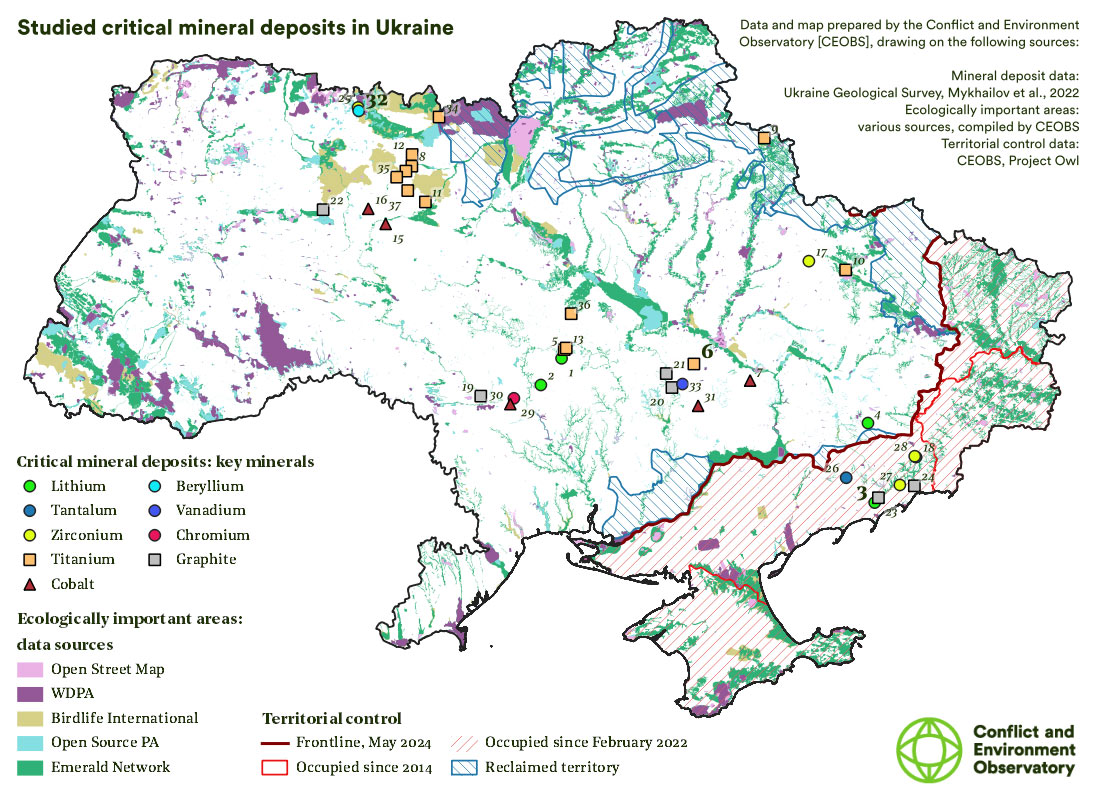
Map credit: Conflict and Environment Observatory
I didn’t give you any information about the poems above so you could feel that these chasms of understanding are in poetry too, and that translating poetry is a bit of a bargaining process as well. The Chinese language, which has origins that are tens of thousands years old, has been used through the ages for some of the most famous poems ever. These poems may have an ‘official’ set of translations to other languages, but with thousands of years of changing cultures, norms, vocabulary and societal conditions, there are perhaps thousands of viable translations that scholars can debate. These translations might significantly alter the interpretation of the poem for those reading in translation, without all that cultural knowledge. Heavyweights like Ezra Pound have tried and failed to do poets like Tang Dynasty‘s Li Bai (Li Po) justice.
The above versions are the original Chinese (700s CE), and then a translation from none other than ChatGPT. I actually think its access to all those documents turned up a pretty good poem (I cannot say how accurate, as I don’t speak Chinese). Below are two human translations, and then Google translate’s version. They are all quite different; sit with their differences and bridge the spaces so that even if the way is hard, we can traverse it together.
Difficult Travel Roads: Three Poems: No. 1
translator unidentified

Very expensive clear wine in a ten liter gold vessel
Very precious jade tray of fine delicacies.
Drop my cup, throw down chopsticks, not able to eat
Grab my sword, heart-mind frustrated by inactivity.

Hope to cross the iced-over Yellow River to reach border strongholds
Ready to challenge Tai Hong mountain, snow covering everything.
Perhaps I can idle myself, fish above a small stream
Dream that the emperor unexpectedly calls on me.

Travel roads difficult, difficult roads to travel
Many forks in the road, does a peaceful one exist?
Like an ancient prince, want to ride the strong winds and broken waves
Raise sails to the clouds, move across deep blue seas.
Hard is the Way of the World
- translator unidentified

Pure wine in golden cup costs ten thousand coins, good!
Choice dish in a jade plate is worth as much, nice food!

Pushing aside my cup and chopsticks, I can’t eat;
Drawing my sword and looking around, I hear my heart beat.

I can’t across Yellow River: ice has stopped its flow;
I can’t climb Mount Tai Hang: the sky is blind with snow.

I poise a fishing pole with ease on the green stream
Or set sail for the sun like the sage in a dream.

Hard is the way, Hard is the way.
Don’t go astray! Whither today?

A time will come to ride the wind and cleave the waves;
I’ll set my cloud-like sail to cross the sea which raves.
Traveling on a Difficult Road: Three Poems
(Google translate)

(1)
Ten thousand gold bottles of clear wine
The jade plate is so precious that it costs ten thousand yuan.
Stop drinking and throw in chopsticks. Can’t eat.
He drew his sword and looked around, feeling confused.
Wanting to cross the Yellow River, ice blocks the river
I will go to Taixing on a snowy and dark day.
Come and fish in your spare time and sit on the stream
Suddenly, I took a boat and dreamed of being near the sun.
The journey is difficult, the journey is difficult
There are many different roads, where are you now?
There will be times when the long wind breaks the waves
Straight up the clouds and sails to help the sea.
 Mereconomics
Wonderful to read this poem. It captures the terrible feeling of leading a rich life while all around huge boulders are crushing others and . . . soon us. What to do, what road.
(Interesting to see the various flat footed translations)
Also, love the road sign at top of the page.
LikeLiked by 1 person