
(Ballad of the tea merchants)
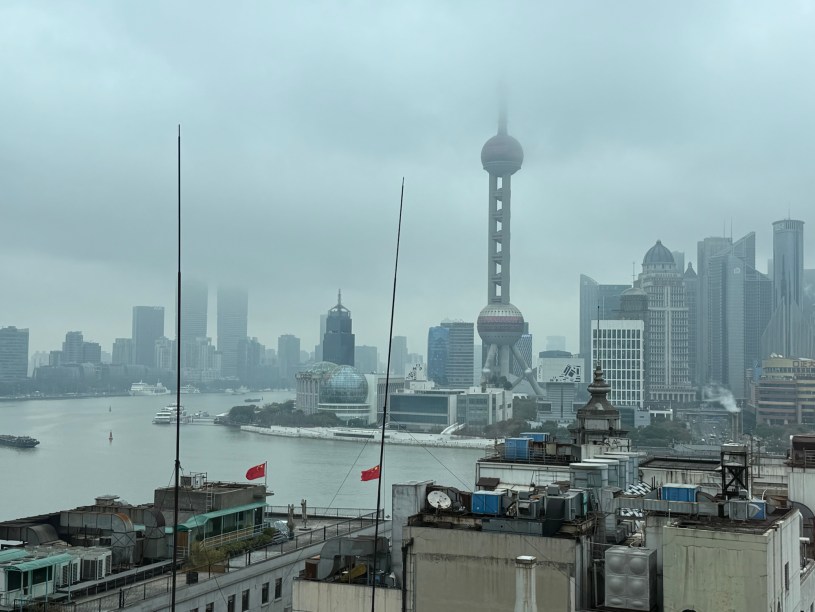
I found myself googling the tower in the misty picture above of the Pearl Oriental TV Tower, which is the view for the night here in one of the world’s greatest commercial centers, Shanghai. This led directly to the poem below, full of sorrow and loss. The particular image of the once-revered woman being “reduced to marrying a tea dealer” strikes me as capturing much of what is happening in education today. There is absolutely nothing wrong with tea trading – I’m sitting enjoying Chinese tea as I write this – but business and academia mix rather poorly. The music and complexity of the human condition is left to the sidelines when academics are told to take the limited business approach, making us all poorer in their absence.
Pipa Song (Pipa Xing)
Bai Juyi(772-846 AD)[1]


Foreword by the poet

 In 815 I was demoted from the Capital to a local Officer of Jiujiang Prefecture. One autumn night of the following year, while seeing off friends on a boat leaving Penpu harbor on the Yangtze River, I suddenly heard a pipa tune being played from the neighboring boat. The music style was clearly from the capital. Being totally surprised, I made an inquiry and learned that the musician was a lady who used to be a famous star in the Capital. She studied the pipa with the great Masters Mu and Cao. Then her glorious years past with the time as her beauty faded. Finally she had to lower herself to marry to a merchant. I then invited her to my boat, had the table re-set, and asked her to perform for my friends and myself. When the concert ended, I asked her why she was so sad. She told me of her splendid youth and how she lost her fame and lived a life of a merchant¡¯s wife. I had not myself felt depressed since my own departure from the capital. But after I heard her story, that night, the reality of my own demotion sank in. And I could not help but write for her this "Pipa Song", a long poem of six hundred and sixteen characters.


One Autumn night on the Yangtze River side,
I bade farewell to my friends on a boat.
Soft wind rustles reeds and maple leaves,
I, the host, dismounted and the guests went aboard.
Cup in hands, but there was no music,
We drank with depressed heart,
Seeing my friends off while the moonlight bathing in the river.
Suddenly the pipa sounds drifting to our ears from a neighboring boat,
My guests forgot to leave and I knew not where we were.
Tracing the sound, we looked for the wonder maker.
The music stopped and there was no sound to hear.
We moved our boat near the musician's to invite
Here to drink at our feast replenished by lamplight.
We urged her over and again until she appeared,
With half her face hiding behind the pipa still.
She turned the pegs and tuned each string few times,
Her music flew out even before playing a note.
Each plug on the string gave a note of melancholy,
Pouring out the resentment of her life.
She knitted up her brows and carried on,
Telling from her heart the life story long.
Now playing softly, now playing swiftly,
She performed first "Liuyiao" and then "Nishang" [2]
The bold strings rattled like splatters of sudden rain,
The fine strings hummed like lovers' whispers.
Chattering and pattering, pattering and chattering,
As pearls, large and small, on a jade plate fall.
The sweet melody recalls oriole singing among flowers,
The sobbing music brings the gushing spring out of glacier,
The spring frozen, the strings ceased vibration.
The water stopped flowing and silence set in.
In my heart, a spell of deep feeling,
At this magical moment, silence tells more than sound.
Suddenly a strain of notes burst out
Like water splattering out of a fallen vase
Or horsemen riding among a forest of spears.
She struck the four strings all at once
As if the silk curtains were ripped with great force.
With her plectrum sweeping over the string,
The music came to an end with a crystal snap.
And tranquil overwhelmed in the boats far and near,
Only the Autumn moon shining in the rever so pale.
Sadly, she put the pick back under the strings
And rose elegantly with her manner respectful,
Saying that she was originated from the capital,
And lived in the famous district of Xiamoling [3].
By thirteen she had mastered the pipa,
And was first among equals at the Imperial Conservatory,
Her art the admiration even of master Shancai,
Her beauty the envy of all pretty girls.
Suitors competed to reward her,
For every song she received endless bolts of silk.
She sang, she beat time, all through the day,
She danced till her head gear fell to the floor.
Wine spilled, skirts stained,
Delicacies rivaled gaieties.
Day after day, and joy upon joy,
Her best years slipped away.
Then her brother joined the army, and her aunt died.
Times changed, and her beauty faded.
Her patrons wandered off, went elsewhere,
And the carriages at her door got fewer and fewer,
Till finally she had to lower herself marry a tea dealer [4].
All he thought of was money, parting never bothers him,
So the month before he'd gone to Fuliang, to buy tea,
And she had been left to tend the boat all alone,
No company but the cold water and the moon.
In the deep of night she would dream of the past,
Awake from Crying, her face wet with tears.
I had sighed when I heard the music,
But now, having heard her story, sadness doubled.
"Both of us are strangers here, both of us stranded,
Does it matter that we've just met, if our hearts understand?
I left the capital a year ago,
And now, a sick exile at JiuJiang, my sorrow grows.
The city is far away, there is no music,
No flute, no pipa, all the year long.
I live, now near Pencheng, damp and low,
Choked with reeds and bamboo.
What do I hear, day and night?
The sad songs of cuckoos, the sad cries of apes.
On a spring day, at the river,
Or on an autumn moonlit night,
Often-I sit up, alone, and sip wine.
There are folk songs, of course, there are village flutes,
But they are so crude and they grate on my ears.
Tonight I heard you play the pipa.
It brightens me like music from Heaven.
Sit down once more, please play an ancore,
And in turn I will write you a "Pipa Song".
Moved by my words, she stood there, silent for a long while,
Then she sat down and quickly tuned her strings again,
Grief-filled and heart-felt she played a different tune.
Tear-soaked, sorrow-laden, all sobbed out at once.
And who was weeping the bitterest tears of all?
The Deputy Chief of Jiujiang Prefecture,
whose blue gown was soaked in tears.

[Note]
[1] Bai Juyi (772-846 AD) is one of the greatest poets in Chinese history. His fame in China is comparable to that of Shakespear in the English speaking world.

[2] Nishang and Liuyao - Popular dance tunes, the former introduced into China from Central Asia;

[3] Xiamoling - red-light district in Changan, the Capital of Tang Dynasty.

[4] In the traditional China, classes in the society are very big spelled. Scholars and learned people were highly respected, and the officials were selected from learned people through strict examinations based on the knowledge about the Chinese classics, literature and poetry. The "businessmen" or the merchants were regarded lowest in society, as these were synonyms for "gready", "selfish" and therefore "low morality". The reason was that "businessmen only looks for profits in term of money".

[Note from the translator]
Translating poetry is difficult; translating Chinese poetry into any other languages is particularly difficult, because the root of Chinese language is the characters that are symbolic images (not real pictures, but meaningful pictures), whereas all western languages are phonetic notes. The meaning of all western languages is transmitted by sounds only, but that of Chinese is by both images and sounds. Even the sounds have various tonalities, when weaved in the verse, creating a musical and rhythmic feeling that is totally lost in any translation, not to speak of the images that come with the characters. The original verses of the above poem are very beautiful in all aspects. In this translation, only the story is kept, thus it can hardly be regarded as poem in terms of rhythm and meaning. Readers are warmly welcome to give us advice and suggestions for improvement.
There are far too many assaults on higher education – and education in general- to name them all here. But schools and their students, faculty and communities are threatened by both funding cuts and attempts to control the research and teaching in schools. Losses from the NIH and NSF grant cuts and revocations that are happening now will have generational impacts and set back innovations in health and science that harm individual and global well-being, even for “red states”. The lost funding means less innovation, fewer doctoral students training for the future, and fewer well educated people overall.
At the same time, universities and schools are now more and more pressed to run like businesses rather than places of learning and scholarship. Faculty are expected to spend more and more time working the grant lottery process and less and less time teaching the next generation or doing the research itself. This is costly and demoralizing. Now we are told any attempts at addressing systemic inequities will also lead to de-funding and ostracism by the federal government.
Increased funding uncertainty means the path to professorship, which was already extremely difficult with perhaps 1 in 10 or even 1 in 30 PhDs making it to full professor, has become even more challenging. Off-ramps are increasingly built in to the system, through dead-end postdocs and adjuncting “gig-academia” posts, more and more closing of “tenure lines” upon retirement rather than replacements, and more and more need to slush through careers on soft money or poorly paid adjunct-work if they want to stay in academia. This fuels the disregard and disrespect for the academy.
Educational funding and academic freedom are not just challenges in America. Many countries have been cutting back on funding for education and directly or indirectly trying to control research agendas. The reasons range from the pragmatic – e.g. Covid was expensive and debts need to be paid – to the political – private funding sources generally have agendas that may not mesh well with public education aims, so the private interests must be accommodated to get the funding.
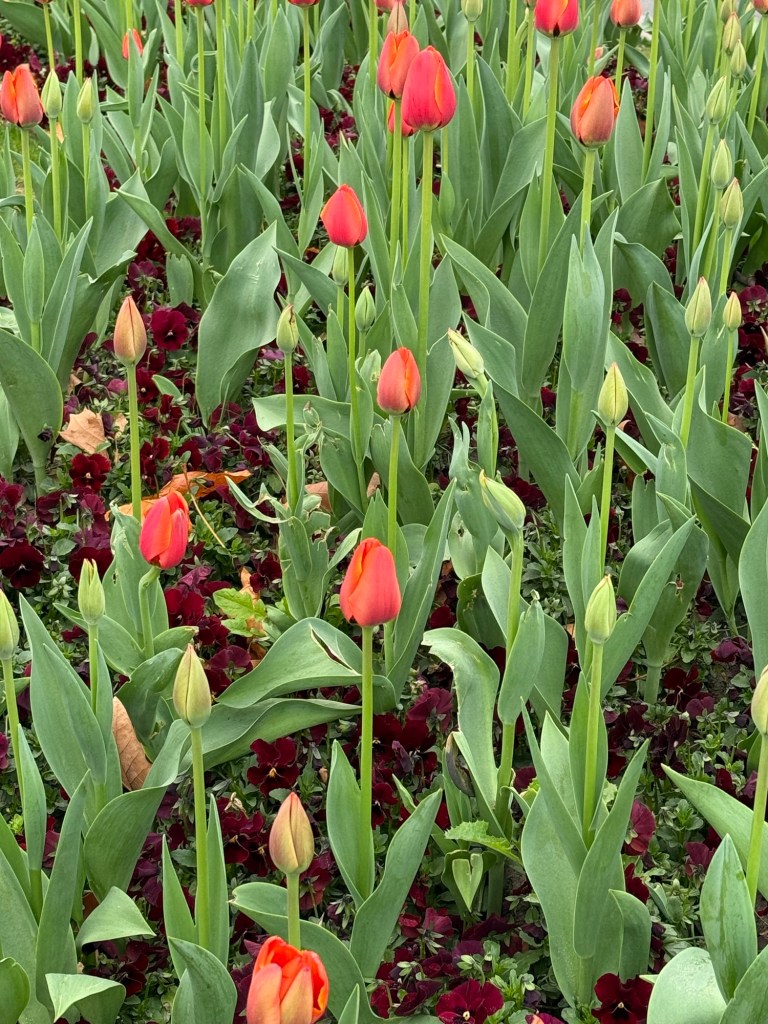
Scholarship will further shrink in scope and ambition to avoid risks and secure private funds. While there can be beauty and order in this, as with the vibrant planted tulips shown here lining The Bund today, we will struggle to understand the whole and lose the global perspective.

This shrinking of perspective and responsibility for the future is hitting primary and secondary education as well. We are apparently dismantling the department of education to “hand it back to the states.” Expect to see more school districts making inappropriate and dangerous choices like using “of pandas and people” as a (creationist) science textbook or not requiring vaccination for students. Don’t expect the courts will be reliable allies, despite past decisions. Plenty of missteps in the ivory towers make education a juicy target, in some aspects rightfully so (a topic for another time perhaps).
Everywhere there is a collective forgetfulness that education has public good and positive externality aspects that mean we should be investing more, not less, since the market underproduces in both cases. The humanities and social sciences are in fact “cheap” compared to sciences that require labs and equipment, yet still they bear much of the burden of reducing the university footprint because it is harder to measure the output or return. It’s easier to demand a share of a scientist’s patentable idea than to capture the value of generating a citizenry with critical thinking skills, historical knowledge and context, and rational decision-making skills. Until the cost of the latter is our democracy, global prosperity and a rules-based world order.
Respect for academics is low and falling. The same is true for teachers in the US, whose demanding jobs are poorly understood or appreciated by many. After centuries of being thought leaders and respected voices of reason, providers of paths to the betterment of our youth and society, our beauty is seen as fading and we are forced to marry the tea-merchants to survive, just as the woman in our poem today, again from the Tang Dynasty in China. Like her, we will still be just as skilled, but relegated to the distant river banks.
Here's the original poem in Chinese:
琵琶行 (Pipa Xing)
白居易(公元772-846)
元和十年,余左迁九江郡司马。明年秋,送客湓浦口, 闻舟中夜弹琵琶者。听其音,铮铮然有京都声。问其人,本长安倡女, 尝学琶琵于穆曹二善才。年长色衰,委身为贾人妇。遂令酒使快弹数曲。 曲罢悯然,自叙少小时欢乐事,今漂沦憔悴,转徒于江湖间余出官二年,恬然自安, 感斯人言,是夕始觉有迁谪意。因为长句歌以赠之,凡六百一十六言。命曰《琵琶行》。
浔阳江头夜送客,枫叶荻花秋瑟瑟。
主人下马客在船,举酒欲饮无管弦。
醉不成欢惨将别,别时茫茫江浸月。
忽闻水上琵琶声,主人忘归客不发。
寻声暗问弹者谁,琵琶声停欲语迟。
移船相近邀相见,添酒回灯重开宴。
千呼万唤始出来,犹抱琵琶半遮面。
转轴拨弦三两声,未成曲调先有情。
弦弦掩抑声声思,似诉平生不得志。
低眉信手续续弹,说尽心中无限事。
轻拢慢撚抹复挑,初为《霓裳》后《六幺》。
大弦嘈嘈如急雨,小弦切切如私语。
嘈嘈切切错杂弹,大珠小珠落玉盘。
间关莺语花底滑,幽咽泉流冰下难。
冰泉冷涩弦凝绝,凝绝不通声渐歇。
别有幽愁暗恨生,此时无声胜有声。
银瓶乍破水浆迸,铁骑突出刀枪鸣。
曲终收拨当心画,四弦一声如裂帛。
东船西舫悄无言,唯见江心秋月白。
沉吟放拨插弦中,整顿衣裳起敛容。
自言本是京城女,家在虾蟆陵下住。
十三学得琵琶成,名属教坊第一部。
曲罢躺撇欧背擅勘磺锬锒省?
五陵年少争缠头,一曲红绡不知数。
钿头云篦击节碎,血色罗裙翻酒污。
今年欢笑复明年,秋月春风等闲度。
弟走从军阿姨死,暮去朝来颜色故。
门前冷落车马稀,老大嫁作商人妇。
商人重利轻别离,前月浮梁买茶去。
去来江口守空船,绕船月明江水寒。
夜深忽梦少年事,梦啼妆泪红阑干。
我闻琵琶已叹息,又闻此语重唧唧。
同是天涯沦落人,相逢何必曾相识!
我从去年辞帝京,谪居卧病浔阳城。
浔阳地僻无音乐,终岁不闻丝竹声。
住近湓江地低湿,黄芦苦竹绕宅生。
其间旦暮闻何物,杜鹃啼血猿哀鸣。
春江花朝秋月夜,往往取酒还独倾。
岂无山歌与村笛,呕哑嘲哳难为听。
今夜闻君琵琶语,如听仙乐耳暂明。
莫辞更坐弹一曲,为君翻作琵琶行。
感我此言良久立,却坐促弦弦转急。
凄凄不似向前声,满座重闻皆掩泣。
座中泣下谁最多?江州司马青衫湿。
As discussed previously, translation of these ancient poems is decidedly challenging. We probably need good scholars to do such work well…
 Mereconomics
Pipa Xing is a melancholic poem that captures the sorrow of fleeting youth, lost dreams, and the shared loneliness between two strangers— a demoted official and a once-celebrated pipa player now abandoned by time and fortune. I think that it fits well with what happens now around us in the world (with so much uncertainty, loss, and rapid change)..
The English translation is OK, it captures the key points. Poems are extremely hard to translate…
LikeLike