
Orwell, with his insight into the essential authoritarian command to reject the evidence of your eyes and ears, continues in the role of prophet in this week’s performance of “You can’t make this sh*t up,” a story of the end of American democracy. He’s supported by George Lucas and Tony Gilroy, who respectively created and developed a “galaxy far, far away” that shares universal truths with our own.
The monster continues to come for us all, and in the clip above, Galactic Senator Mon Mothma reminds us that, “the distance between what is said, and what is known to be true, has become an abyss…When truth leaves us, when we let it slip away, when it is ripped from our hands, we become vulnerable to whatever monster screams the loudest.”
The losses are mounting, individually and collectively. The erosion of truth so blaringly underlined by the firing of Bureau of Labor Statistics commissioner Erika McEntarfer after the jobs numbers did not fit the administration’s false narrative provides yet another attempt to shift the norms toward authoritarianism. It needs hardly be said that losses will extend far beyond her individual position or even the job losses the data show, to include loss of trust, national and global reputation, and the ability to understand present and future events and economic conditions. PBS (now itself suffering because of its truth telling) interviewed the previous BLS head William Beach (appointed in the 45 presidency) to sum up the crazy assertions from the administration, and truths about how BLS statistics work here. Beach’s assessment does perhaps allow a little too much optimism for our ability to recover from this loss, claiming that the US Senate might actually do its job in vetting the replacement. I won’t hold my breath for that though.
The poem today is pretty on the nose for the news, and needs little explanation.
A Word on Statistics (trs. by Joanna Trzeciak)
By Wisława Szymborska
Translated By Joanna Trzeciak

Out of every hundred people

those who always know better:
fifty-two.

Unsure of every step:
almost all the rest.

Ready to help,
if it doesn't take long:
forty-nine.

Always good,
because they cannot be otherwise:
four—well, maybe five.

Able to admire without envy:
eighteen.

Led to error
by youth (which passes):
sixty, plus or minus.

Those not to be messed with:
forty and four.

Living in constant fear
of someone or something:
seventy-seven.

Capable of happiness:
twenty-some-odd at most.

Harmless alone,
turning savage in crowds:
more than half, for sure.

Cruel
when forced by circumstances:
it's better not to know,
not even approximately.

Wise in hindsight:
not many more
than wise in foresight.

Getting nothing out of life except things:
thirty
(though I would like to be wrong).

Doubled over in pain
and without a flashlight in the dark:
eighty-three, sooner or later.

Those who are just:
quite a few at thirty-five.

But if it takes effort to understand:
three.

Worthy of empathy:
ninety-nine.

Mortal:
one hundred out of one hundred—
a figure that has never varied yet.


Copyright Credit: Wislawa Szymborska, "A Word on Statistics" from Miracle Fair.  Copyright © 2002 by Wislawa Szymborska.  Reprinted by permission of W. W. Norton & Company, Inc.
Source: Miracle Fair (W. W. Norton & Company, Inc., 2002)
Author note: The last stanza is extra-poignant on the personal level, unfortunately, with the recent loss of my father: Star Wars fan, values-based investor, world navigator and much more.
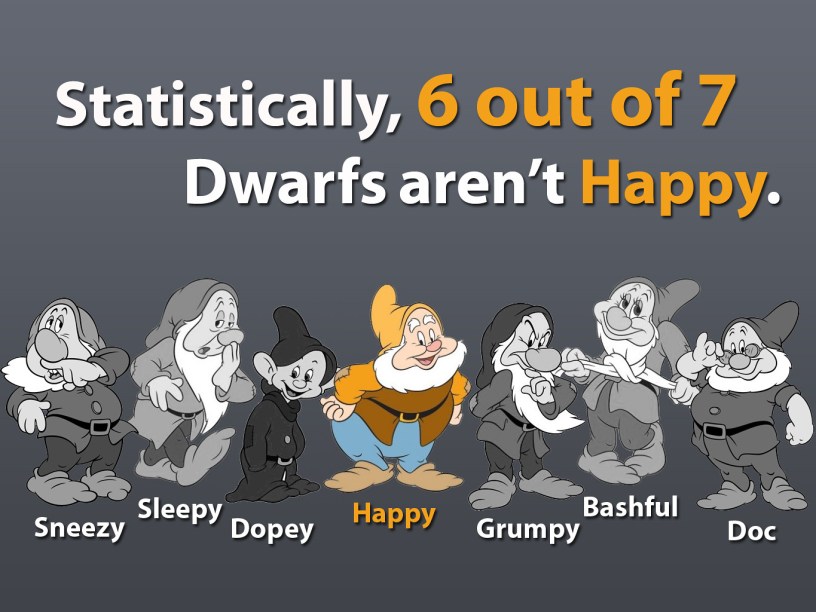
Cover image credit: Happiness Statistics. 47% of Americans struggle to stay happy. 85% of the Seven Dwarfs aren’t happy. www.humorthatworks.com Credit: Andrew Tarvin
 Mereconomics