
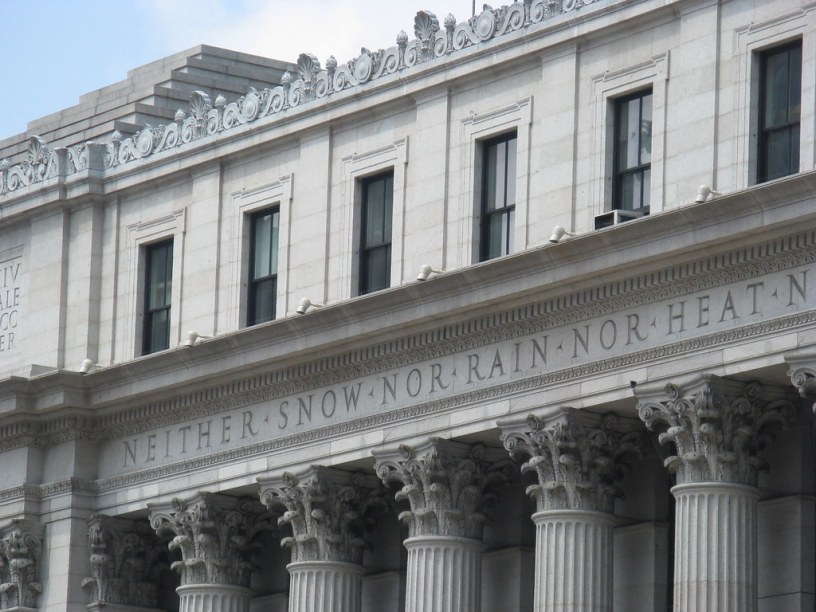
The US Postal Service has a mission that reflects the importance of correspondence and sharing information, as shown here:
The Postal Service shall have as its basic function the obligation to provide postal services to bind the Nation together through the personal, educational, literary, and business correspondence of the people. It shall provide prompt, reliable, and efficient services to patrons in all areas and shall render postal services to all communities.
Versions of this mission are shared by postal services all over the world. And these services are under threat around the world as well – as evidenced by Denmark’s decision to stop delivering physical letters as a public service starting this winter. This may save money, but has potential for serious negative consequences in the short and long run, including exacerbating loneliness and disconnection amongst vulnerable populations, even in a country acknowledged for having the most digital citizens of all.
Today in the US, we have the news that postal services around the world are no longer willing to convey packages to the US, due to the chaos of the new tariff requirements. They may still deliver letters, for now, but with letters leaving their own services, it seems unlikely to last for the US much longer. And the US is nowhere near the top of the digitalized citizens list.
We find one more instance of longstanding globalization benefits disappearing and isolationism continuing to grow. Business costs and uncertainties will grow; channels of trade and communication will falter. At the personal level, this can be expected to increase stress on US expats and their families looking to keep closer bonds as well. Sure, some private monopolies might spring up, but this will increase costs and have less oversight, further reducing interest and tearing at the social fabric. The selected poem today describes well the longstanding connections forged by mail (and rail):
Night Mail
W.H. Auden

This is the night mail crossing the Border,
Bringing the cheque and the postal order,

Letters for the rich, letters for the poor,
The shop at the corner, the girl next door.

Pulling up Beattock, a steady climb:
The gradient's against her, but she's on time.

Past cotton-grass and moorland boulder
Shovelling white steam over her shoulder,

Snorting noisily as she passes
Silent miles of wind-bent grasses.

Birds turn their heads as she approaches,
Stare from bushes at her blank-faced coaches.

Sheep-dogs cannot turn her course;
They slumber on with paws across.

In the farm she passes no one wakes,
But a jug in a bedroom gently shakes.


Dawn freshens, Her climb is done.
Down towards Glasgow she descends,
Towards the steam tugs yelping down a glade of cranes
Towards the fields of apparatus, the furnaces
Set on the dark plain like gigantic chessmen.
All Scotland waits for her:
In dark glens, beside pale-green lochs
Men long for news.


Letters of thanks, letters from banks,
Letters of joy from girl and boy,
Receipted bills and invitations
To inspect new stock or to visit relations,
And applications for situations,
And timid lovers' declarations,
And gossip, gossip from all the nations,
News circumstantial, news financial,
Letters with holiday snaps to enlarge in,
Letters with faces scrawled on the margin,
Letters from uncles, cousins, and aunts,
Letters to Scotland from the South of France,
Letters of condolence to Highlands and Lowlands
Written on paper of every hue,
The pink, the violet, the white and the blue,
The chatty, the catty, the boring, the adoring,
The cold and official and the heart's outpouring,
Clever, stupid, short and long,
The typed and the printed and the spelt all wrong.

Thousands are still asleep,
Dreaming of terrifying monsters
Or of friendly tea beside the band in Cranston's or Crawford's:

Asleep in working Glasgow, asleep in well-set Edinburgh,
Asleep in granite Aberdeen,
They continue their dreams,
But shall wake soon and hope for letters,
And none will hear the postman's knock
Without a quickening of the heart,
For who can bear to feel himself forgotten?
The origins of recognition for the importance of postal services go much further back than Auden’s poem, however – the ‘unofficial motto’ of the USPS is “Neither snow nor rain nor heat nor gloom of night stays these couriers from the swift completion of their appointed rounds.” – a phrase taken from Herodotus’ description of the impressive role of Persian messengers in the 6th Century BCE Persian Wars with Greece. It’s not just hundreds of years of progress we are derailing, but millennia. If you were looking for a sign to write that snail mail, send that letter, build that connection, do it!
While Xerxes did thus, he sent a messenger to Persia with news of his present misfortune. Now there is nothing mortal that accomplishes a course more swiftly than do these messengers, by the Persians’ skillful contrivance. It is said that as many days as there are in the whole journey, so many are the men and horses that stand along the road, each horse and man at the interval of a day’s journey. These are stopped neither by snow nor rain nor heat nor darkness from accomplishing their appointed course with all speed. [2] The first rider delivers his charge to the second, the second to the third, and thence it passes on from hand to hand, even as in the Greek torch-bearers’ race in honor of Hephaestus. This riding-post is called in Persia, angareion.
Herodotus, The Histories Ch. 8.98, with an English translation by A. D. Godley. Cambridge. Harvard University Press. 1920.
(Original Greek) ταῦτά τε ἅμα Ξέρξης ἐποίεε καὶ ἔπεμπε ἐς Πέρσας ἀγγελέοντα τὴν παρεοῦσάν σφι συμφορήν. τούτων δὲ τῶν ἀγγέλων ἐστὶ οὐδὲν ὅ τι θᾶσσον παραγίνεται θνητὸν ἐόν: οὕτω τοῖσι Πέρσῃσι ἐξεύρηται τοῦτο. λέγουσι γὰρ ὡς ὁσέων ἂν ἡμερέων ᾖ ἡ πᾶσα ὁδός, τοσοῦτοι ἵπποι τε καὶ ἄνδρες διεστᾶσι κατὰ ἡμερησίην ὁδὸν ἑκάστην ἵππος τε καὶ ἀνὴρ τεταγμένος: τοὺς οὔτε νιφετός, οὐκ ὄμβρος, οὐ καῦμα, οὐ νὺξ ἔργει μὴ οὐ κατανύσαι τὸν προκείμενον αὐτῷ δρόμον τὴν ταχίστην. [2] ὁ μὲν δὴ πρῶτος δραμὼν παραδιδοῖ τὰ ἐντεταλμένα τῷ δευτέρῳ, ὁ δὲ δεύτερος τῷ τρίτῳ: τὸ δὲ ἐνθεῦτεν ἤδη κατ᾽ ἄλλον καὶ ἄλλον διεξέρχεται παραδιδόμενα, κατά περ ἐν Ἕλλησι ἡ λαμπαδηφορίη τὴν τῷ Ἡφαίστῳ ἐπιτελέουσι. τοῦτο τὸ δράμημα τῶν ἵππων καλέουσι Πέρσαι ἀγγαρήιον.
Image credit: https://www.flickr.com/photos/kevandotorg/4690346073/sizes/l
 Mereconomics