
In another century I started at the programme forest and nature conservation at Wageningen University. Admittedly it was the last year of the previous century (I’m not that old), but still, it is a long time ago.
One of the earliest courses in that programme was “Maatschappelijke betekenis van bos en natuur”, roughly translated as “Social relevance of forests and nature”, taught at the time by Freerk Wiersum. A large chunk of that course was dedicated to the question: “What is nature?” and “What is forest?” This, it turned out, proved to be one of the hardest questions to answer.
First of all, it will be obvious to most people that not all nature, however you define it, consists of forests. Sure, there is the Amazon rainforest, and the tropical rain forests in Africa and Asia, and large stretches of wildland forests in Siberia, but there’s lots of other nature too. There are rivers, lakes, seas, oceans, meadows, mountains, you name it.
Even defining what we consider a forest is hard to pinpoint. If an area contains mainly plants with a wooden stem that do not grow beyond say 50 cm (as trees tend to do when it’s very cold) is it still considered a forest? Or do we want a minimum height too? Is there a requirement on minimum species diversity or is a monoculture of scotch pine (Pinus sylvestris1)[1] enough? And does the species matter? A fellow student once remarked about a poplar forest in one of our Dutch polders: “That’s not a forest, it’s just a nice collection of trees!”
But I want to go back to nature (pun intended). What do we consider nature? When you ask people on the street, most people will either talk about “species other than humans,” mainly plants and animals or about “areas untouched or unaffected by humans.” In this latter interpretation nature would certainly not exist in small countries like the Netherlands or Denmark, and given the scale of human activity, I doubt there is a spot on earth we can actually call nature when we use this definition. The previously mentioned Amazon and Siberian forests are both affected by climate change albeit in very different ways. Even in outer space we are sending radio and electronic waves and there’s a lot of space waste orbiting around earth, and so there is very little that is really untouched.
The latter interpretation is also of interest to economists, and especially environmental economists and economists interested in new forms of economy. One of the criticisms of economic models, and neoclassical growth models in particular (note that neoclassical growth models are NOT the same as neoclassical economics, see Mainstream economics, what it is and what it is not) is that we have placed humans outside of nature, distinct from it, whereas we are actually part of the system. This is one of the main points of the Dasgupta review (The fault is not in economics; it lies in the way we have chosen to practice it.). But if we hold on to the view that nature is areas that are untouched by humans, that means we can actually separate the two. Whenever humans are involved, things are no longer nature by this definition, and because we humans and the influence we have is so omnipresent nature as such does not exist.
The other take on nature would mean that in a way humans are part of the system, but that also means we have to accept that our influence, in the basis, is the same as that of other species. Certainly the scale is different but other species also do things we consider specific to humans. For example:
- Animals “build” roads (think: wildlife trails) and houses (nests, dens etc).
- Plants and animals use chemicals both as weapon (one of the strongest poisons known is botoxine, which is of biological origin) and as medicine (urangutans are known to eat certain plants and fruits to cure illnesses)
- Ants practice agriculture (certain species of ants grow fungi for food in their nests) and keep livestock (aphids, actively herding them).
In many facets, then, we are not so different after all.
I find this an interesting debate, especially in nature conservation. You often hear we should protect nature by restoring it to its natural state, “before humans came along and spoiled everything”. But if that is the case, it places us outside of nature again. If we are part of nature, we cannot spoil it. Sure, we can alter the ecosystems, but that in itself is not unnatural. A similar argument applies to invasive species. These are considered “exotic” because they have been brought in by humans. But if we are part of nature, then we are also part of dispersal processes (like many other animals are). Sure, the scale is different again, and species arrive on locations they would probably not have arrived otherwise, but that in itself is not unnatural as such. We might not like the consequences, but that’s a different story.
That is not to say that I think trying to keep ecosystems in the state they were in before humans had a large influence, or try to restore them to such a state is unworthy. I do think it is a good idea to do so, but for the right reasons. The right reasons are because we as humans think it’s a good idea, for example because it provides us with goods and services or because we want to study it, or because we care about certain species, or even more general because we think it’s our moral duty (for example if you’re a Kantian, or if it’s in line with the religious commandments that you adhere to).
The wrong reason, to my mind, is to bring it back to “the natural” state or equilibrium2. First of all because it’s not given that an equilibrium or steady state exists (see for example: Fussman and Heber 2002 or Rogers et al. 2022), and second because it implies that we are not part of nature, that nature exists outside of us. That was exactly the kind of reasoning we wanted to avoid.
So what do we value nature for? Economists and others have come up with a classification of reasons why we value nature and ecosystems. Admittedly it is a subject of debate if we even can classify that (if only because it’s a limited anthropogenic viewpoint) and what the exact categories should be. One such framework is the Common International Classification of Ecosystem Services (CICES), that was started by the Millennium Ecosystem Assessment, and built from there. A picture with some examples is shown below.
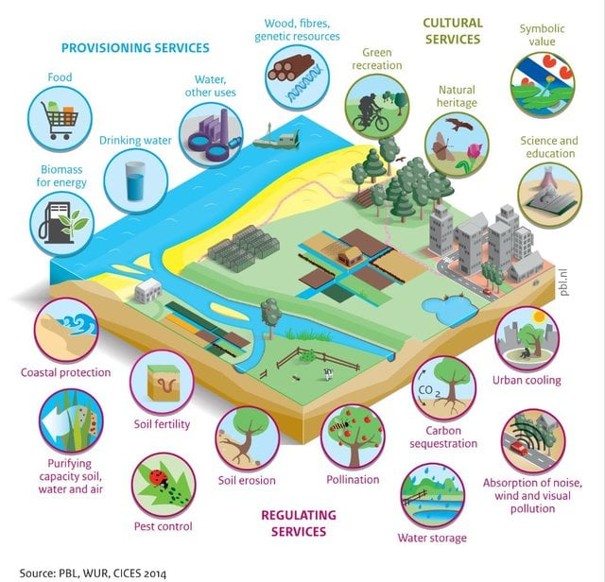
As shown in the picture, apart from the obvious reasons as to why we value nature such as provision of food, water and other natural resources, there is also a large part reserved for cultural services. Recreation, natural heritage, symbolic value contribute to our well-being.
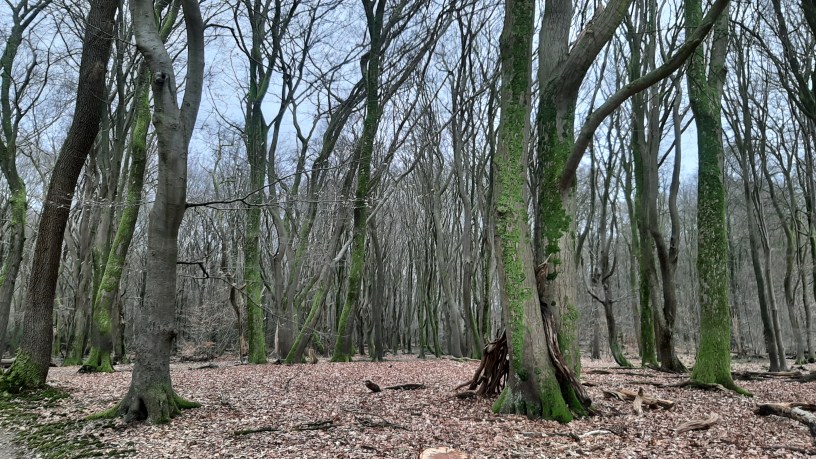
One part I personally like is the Speulderbos, sometimes called the forest of the dancing trees near Garderen (cover picture), a forest we visited as part of the aforementioned program in forest and nature conservation. The trees have been left alone for a long while and grow in all directions and shapes, and are as a consequence, valueless from a wood harvesting perspective. They are, however, very enjoyable to see because they look so natural and wild. And right there we have the paradox again: we value those areas often because they offer a contrast with our day-to-day tamed environment. We want nature to be wild, free from human influence.
This is also, in part, the driving force after the rewilding movement, that tries to restore original ecosystem dynamics and natural processes. An amusing satire on the problems we run into when trying to implement rewilding was recently published by Winkel and Sheil (2026). The title says it all: Keeping nature acceptable: A modest proposal for responsible wildness.
I don’t think we will ever fully resolve the debate on what we consider nature and the relationship between “human environment” and “natural environment”. That the contrast has been a source of enjoyment and debate for a long time in the Netherlands is shown by the sonnet by J.C. Bloem below. For the rest the relationship will probably remain what it is now: living apart together.
De Dapperstraat
–
Natuur is voor tevredenen of legen.
En dan: wat is natuur nog in dit land?
Een stukje bos, ter grootte van een krant,
Een heuvel met wat villaatjes ertegen.
–
Geef mij de grauwe, stedelijke wegen,
De in kaden vastgeklonken waterkant,
De wolken, nooit zo schoon dan als ze, omrand
Door zolderramen, langs de lucht bewegen.
–
Alles is veel voor wie niet veel verwacht.
Het leven houdt zijn wonderen verborgen
Tot het ze, opeens, toont in hun hoge staat.
–
Dit heb ik bij mijzelve overdacht,
Verregend, op een miezerige morgen,
Domweg gelukkig, in de Dapperstraat.
–
–
J.C. Bloem (1887-1966)
Pick your own favourite translation at:
http://subtexttranslations.com/drptp/bloem/bloem.html
Image credits:
Cover photo: Maarten Punt
CICES classification illustration: Koets MJ, Renes G, Ruijs A and De Zeeuw AJ. (2017). Relative price increase for nature and ecosystem services in cost-benefit analysis. PBL Netherlands Environmental Assessment Agency, The Hague. https://www.pbl.nl/uploads/default/downloads/PBL_2018_-_background_study_-_relative_price_increase_for_nature_and_ecosystem_services_-_3214.pdf
- Ironically the literal translation of its Latin name is pine tree of the forest. To add to the irony Scotch Pine is what is called a pioneer species in ecology, that is, it thrives in habitats that are barren, where few other species occur and, in case of Scotch Pine, where there’s a lot of light. That’s not in most forests. At best it’s forest forming tree. ↩︎
- The theories of economists are full of equilibria and steady states, and so are some of the theories of ecologists. What they also have in common is that these equilibria tend to be static and single in basic courses and more dynamic and multiple in advanced courses ↩︎

